Showing posts with label Friendship. Show all posts

Sunday, April 17, 2011

Stephen King’s It

Stephen King’s It on IMDB
If you know the novel on which this two-part made-for-tv film is based, you’ll know it’s impossible to transfer the story from one medium to another. I guess we should give Warner Bros. kudos for even trying. The result, though, is neither scary nor compelling. I imagine that if this were the first horror movie you ever saw when you were a teenager it might have been quite creepy – and you’ll be traumatized for life by that clown. “They all float down here!” The story follows a group of kids, “The Loser Club” (later re-baptized as “Lucky Seven”) during a life-changing summer in 1960 – and their reunion thirty years later. In that fateful summer in some New England smallville, all of them have frightful encounters with their worst nightmare in the form of shape-shifting Pennywise the Dancing Clown, who also appears as a werewolf, a mummy, and whatnot. Children disappear in sleepy little town of Derry, Maine, but no one seems to care or do much about it. Grownups apparently don’t notice what is going on in their town every thirty odd years. The losers’ leader, Bill is determined to avenge the death of his younger brother Georgie. When they all have shared their encounters with “It” they agree to help him. Obviously they have no idea how to go about, but the bonding experience is the heart and soul of the story.

Unable to kill the monster, they vow they will one day return to finish “It” off should it ever come back. And coming back it does, as children sing “Itsy Bitsy Spider” and disappear again thirty years later. Mike Hanlon is the only one of the Lucky Seven who remains in Derry and contacts the others; Bill Denbrough (doubtless modeled after Stephen King himself) still tells scary stories; Richie Tozier now makes a living cracking jokes as he always did; that little fat kid, Ben Hanscom, who used to build dams so well, is now a slim, successful architect; hypochondriac Eddie Kaspbrak still lives with his overbearing mother; the only girl among the Losers, Beverly Marsh, has found a man to replace her abusive father; Stan Uris, once the goody-two-shoes boy scout and now a successful businessman, rather commits suicide than face “It” again. There’s no explanation why they are still able to see that freaky Pennywise the Clown now that they’re adults, and there certainly aren’t words to explain the dramatically poor ending. Somehow the clown’s true earthly shape is that of a giant spider that feeds on humans. Mike and Eddie die, while Beverley slings silver slugs at the monster, while Bill, Richie and Ben disembowel “It” and rip it’s heart out. What a letdown. After sitting through three hours of build up, this crock o’ shyte is a real anti-climax.

There are some obvious staples of Stephen King’s usual fair in the film: the everyman smallville setting in Maine, the coming-of-age of a group of misfit adolescents over a summer in the 60s, the inexplicable terror, and so on. The scenes with the teenagers are perhaps the most interesting, while the adult actors remain stiff and unconvincing. Watching it now, the movie also suffers from its painfully out-dated effects. But what bothers your Cricket most are the blatant rip offs from J. R. R. Tolkien and H. P. Lovecraft. The giant spider in the subterranean cave, feeding on humans paralyzed in cobweb cocoons, clearly derives – however unconsciously – from The Lord of the Rings’ Cirith Ungol’s Shelob. (And if you’ve seen both movies, you’ll probably agree that Peter Jackson stole it back for his version.) The cosmological back-story about the ancient extra-terrestrial monster terrorizing New England, hunting small towns for prey, taking shapes and forms that will terrify anyone who dares looking straight into the “deadlight” of its very being so much their stupefying madness will kill them, certainly comes directly from the Cthulu Cycle, which itself in a way was inspired by Arthur Machen. Moreover, there’s no subtext, no deeper meaning, beyond the great adventure that bound the Losers’ Club in their quest to fight Evil incarnate. And we already knew that clowns are Satan’s spawn. No cheeping chirps for this one.

Monday, November 15, 2010

Danger After Dark II

Noriko’s Dinner Table movie review on NY Times
Noriko’s Dinner Table (2006) by Sion Sono is a companion piece to Suicide Club (2002). However, it’s neither a prequel nor a sequel. Noriko is an awkwardly shy town girl, desperate to break away from her boredom. Her only friends she meets online. In voice-over narrations she tells us how it is she came to Tokyo. When she first meets her online pal (about half an hour into the movie), you just know things are going to get seriously weird. The pal introduces herself as Kumiko. And just so you know we’re talking seriously messed up we flash forward straight away to half a year later when fifty four girls cheerfully jump in front of the 7:30 train at Shinjuku Station. Meanwhile, Noriko’s family has no clue where she is. Her sister Yuka is still in Yokohama, too, happily telling her boyfriend how her sister may have been one of the suicide girls, and that she knows how all the girls arranged to meet at the station. She shows him the screen with the red and white dots: red for female suicides, white for male. Suddenly the screen turns black with the text, “Am I connected with myself, Sis?” She leaves home, too, but leaving her father clues that he manages to put together: the Suicide Club does exist. For her part, Noriko idealized Kumiko’s happy family: they are connected and share their love at all times. She learns to connect with herself – and empathize with others. Kumiko works in “family rental” pretending to be some client’s family member for money. In his own search to find his daughters, Noriko’s father learns that he really is in search of himself. Like its predecessor, this film thus explores computer-age alienation, the loss of connectedness, and emotional isolation in modern urban society. If you were expecting another splatterfest, though, you will be disappointed as the movie is more of a psychological drama. It is also one of the rare occasions where the cinematographic effects (fast editing, dangling cameras, etc.) actually work well to convey the emotional landscape of the characters.

2LDK movie review on NY TimesAragami (2003) by Ryuhei Kitamura is the counterpart of Yukihiko Tsutsumi’s 2LDK (2002). This film, too, features mainly two actors battling, set within a single set, and was produced within one week. But that is where the similarities end. Interestingly, while the cinematography (as well as the continuous electronic pop rock synthesizer soundtrack) is decidedly modern, the story is set in a once-upon-a-time far-faraway, reminiscent of a traditional Japanese tale. A samurai regains consciousness in a remote mountain temple after falling at the entrance with life-threatening wounds. He learns that his companion did not survive, but the inhabitant of the temple invites him to stay and entertains him with a luscious meal, French wine and Russian vodka. He regales the samurai with frightful stories about Tengu (long-nosed mountain goblins) and Aragami, the Raging God of Battle. The samurai soon discovers that his wounds have all healed, but how? His host explains he gave him his friend’s flesh! But who is this host? He was once the legendary Miyamoto Musashi, the greatest warrior ever known, but now has become none other than Aragami himself! They duel, but even when Aragami runs his blade through the samurai’s stomach, it leaves only a scratch. His wounds heal due to the cannibalistic meal, but he is not immortal, as the head or the heart will kill him dead. Aragami has become weary of his existence and hopes this samurai will be the one to kill him honorably. Although the sword-fighting acrobatics are worth the watch alone, it’s the increasing psychological tension that makes this film a satisfying experience. Quite a feat considering the constrained conditions of two actors in a single set!

Glamorous Life movie review on NY TimesBefore we get to The Glamorous Life of Sachiko Hanai (2003) by Mitsuru Meike, it might be useful to first discuss (however briefly) the pinku eiga genre. Pinku eiga emerged in the 60s as a genre evading Japanese censorship laws by blocking or blurring genitals while maintaining a required minimum quota of sex scenes (some four or five per hour). Terms such as “soft-core” or “sexploitation” are somewhat misleading, as the genre often contains elements of action, thriller, violence, horror, and/or political commentary. In this case, the titular Sachiko Hanai is a role-play call girl specialized in playing home-tutoring. What sets the narrative is that Sachiko next gets hit by a bullet in the forehead while trying to take a picture of a shady business transaction running foul between a North Korean and Middle Eastern in a cafeteria. Miraculously, she survives, but the bullet lodged in her brain spurts her intelligence to ponder the abstract universe and subjective truth in mathematical equations. Plus, she can foresee future events, which involve sex and violence – and she finds she has a much delayed taste sensation. We are bombarded with musings about situationalism, rationalism and the Platonist view on Christianity, objective reality and Japan’s lack of a nuclear military strategy to match that of Russia or the U.S, all combined with sex (not the sensual erotic or even graphic pornographic kind, but of the prosaic, romping, five-minute sort – including six gallon ejaculations). Sachiko also discovers a silver cylinder containing a clone of George W’s finger. He appears to her in a reflection urging her to defend world peace and democracy. I’m sure you can guess where that finger is going. While she is climaxing, we are shown images of the U.S. invasion of Iraq, the toppling of Saddam Hussein’s statue, and of Bush inspecting his fleet. Meanwhile, the North Korean who shot her in the cafeteria hopes to retrieve Bush’s finger, for it controls nuclear Armageddon. In the end, after abstract infinity, cogito ergo sum, beef stew, dues ex machina, and more sex, Sachiko walks out of a primordial cave straight into nuclear obliteration. A must see!

Monday, October 4, 2010

Danger After Dark

Suicide Club movie review on NY Times
Not too long ago, the Movie Cricket borrowed a box set of Japanese movies. The one that I really wanted to see again was Suicide Club (Jisatsu Sākuru, 2002). That film, directed by Sion Sono, opens with one of the most memorable cinematographic scenes you will ever see: young girls come walking down the stairs onto the train platform, in their school uniforms, they step up to the edge, hold hands, and on the count of three all fifty-four jump in front of the train together, blood and body parts gusting all over. With more and more suicides happening, the police are left clueless about their connection. Are they dealing with a cult, or a fad? In that respect, the story is a murder mystery, but one larded with tropes of the horror genre: rainy nights, dark and empty office building, curtains flowing in the breeze, power failure, splatter and gore, strips of human skin. Then there’s the all-girl idol-group Dessert, who sing about e-mails and jigsaw puzzles. Gradually things get more and more weird, to the point of a psychedelic trip into delirious hallucinations and delusions of glam-glitter grandeur. “I want to die as beautifully as Joan of Arc inside a Bresson film,” some psychotic freak sings, “Lesson one: apply the shaving cream – and smile as you then slowly slice away the heart.” In all, this is an exploration of isolation in urban Tokyo, of alienation in modern society; a social commentary of the dehumanization of online interacting and pop culture mass media; and about people finding meaningful relationships in committing mass suicide.

2LDK movie review on NY TimesNext up in the box comes 2LDK (2002), directed by Yukihiko Tsutsumi, about two roommates (played by the beautiful Eiko Koike and Maho Nonami). (The title is a classified ad abbreviation for a 2-bedroom apartment, with shared living room, dining room and kitchen.) One is a neat, reclusive country girl who only recently arrived in Tokyo; the other is a fabulous hip chick with money to burn on Gucci, Miu Miu, Chanel and Hermès. One is a well-educated lover of theater; the other is an air-head beauty pageant queen who began her acting career in porn. One plays classical piano; the other listens to heavy metal. (Guess who the Cricket was rooting for.) They find out that they are competing for the same lead role; the extrovert Lana taunts the introvert Nozomi about a man she has a crush on; but Lana is also jealous about Nozomi’s bigger breasts. In the close confinement of their apartment (the whole film is set within the titular 2LDK), their petty quarrels soon escalate from insecurities and envy to mutual murderous hatred. Thematically there are some parallels with Suicide Club, in that 2LDK also deals with isolation in urban Tokyo, but rather than turning that social seclusion inwards, this film unleashes the claustrophobic and paranoid violence outwards between the two young women. And that violent rivalry is brutally ugly. For a film shot on one set within a week with only two actresses, it is quite an achievement to keep the viewer engaged, but the performances, the dialog, and the cinematography and offering excellent, though gory, entertainment.

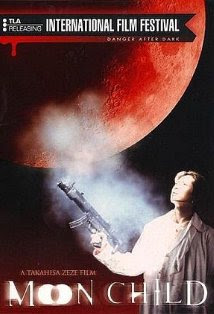
Moon Child on IMDBThe last movie of the set is Moon Child (2003), directed by Takahisa Zeze, and stars J-pop idols Hideto “Hyde” Takarai and Gakuto “Gackt” Kamui (who also co-wrote the script). This film is a futuristic science-fiction martial-arts gay-glam vampire organized crime action horror thriller comedy drama. It follows the life of orphaned Sho (Gackt) and his friends through the first half century of the 21st millennium, when Japan has suffered a major economic collapse and many people have taken refuge in the multi-ethnic “Asian Special Economic Zone” of Mallepa on mainland China. The Mallepa Orphans make their living through robbery and in so doing run into conflict with the Cantonese mafia. The orphans have one advantage, their guardian Kei (Hyde) who happens to be a vampire. Gradually the group of friends falls apart, while Kei is imprisoned. In essence, then, this is a story of love and friendship, the ties that bind. Kei provides the common trope in vampire stories, that is, the loneliness that comes with immortality as friends become mere drops in the ocean, tears in the rain, that wash away in the sad agelessness of the undead. Unfortunately the movie employs those musical interludes – when the writers have to move the story forward, but can’t write a script for the scene. The film also drags on for two full hours, resorts to the cheap and cheesy ploy of cancer to bring Kei and Sho together one last time, and ends with a dual suicide at sunrise. In all, it’s not an awful movie, but it isn’t one that comes with the Cricket’s chirpiest recommendation.

You may now find a follow up of sorts: Danger After Dark II!

[A special shout out goes to Anthony and Sander!]