Showing posts with label Fish. Show all posts

Wednesday, November 3, 2010

BBC Oceans: Mediterranean Sea

Oceans: Mediterranean Sea
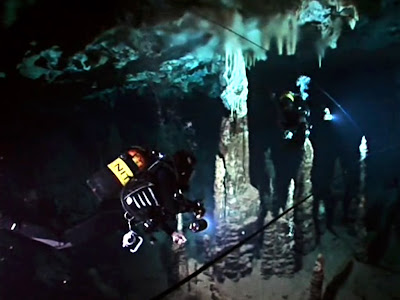
The secrets of the earth’s oceans have remained largely undiscovered. Our oceanographic exploration team is trying to put the world’s oceans in a human scale. This time the expedition is headed for the Mediterranean, which last time the Cricket checked wasn’t technically an ocean, but we are informed it is in fact the remains of an ancient ocean. It is home to about ten percent of the planet’s marine life, Western civilization developed around its shores, and the hundred million visitors every year are having a profound effect on these waters. When maritime archaeologist Lucy Blue sets out to dive the remains of a Roman shipwreck, I was hoping for a site of a naval battle during the First Punic War, because they do take us to near the Egadi Islands (site of the war’s last battle in 241 BCE). Alas, all we get is a pottery field of amphorae. Truly incredible, though, is the footage of Paul Rose and Tooni Mahto seemingly flying through the clear water of an underwater cave beneath Mallorca. Spectacularly sculptural stalactites and stalagmites indicate that tens of thousands of years ago these caves were above the water line until the sea level rose and flooded them with salt water.

Around the submerged Ferdinandea volcano, created by the collision of the European and African continents, the team learns that industrial fishing has extinguished larger fish such as sardines and tuna – indicating that the entire eco-system may be at risk. Environmentalist Philippe Cousteau Jr. then inspects a blue-fin tuna farm. Glad as he is seeing these beautiful fish, he is obviously enraged, knowing how they are on the brink of extinction once again due to overfishing. Later, Philippe and the team search for the great white shark, as the Sicilian Channel is a nursery for its juveniles. But despite all their efforts they remain unsuccessful. In the Straits of Messina (where the First Punic War commenced), however, expedition leader Paul Rose is able to sight the prehistoric six-gill shark, the largest living predatory fish. And what a marvelous sight it is!

Tuesday, October 26, 2010

BBC Oceans: Indian Ocean - coastal waters

Oceans: Indian Ocean - coastal waters
Oceans cover two-thirds of our planet, they hold clues to the mysteries of our past, and are vital for our future survival. That is the message this BBC nature documentary has been trying to get across. In this second installment about the Indian Ocean the focus is on the Spice Islands off Tanzania, on the edge of two continents, where the full force of the Indian Ocean collides with the African coast. These waters are a nursery supporting an enormous diversity of marine life. But the ocean’s currents can also cause unpredictably heavy weather (rain, storm, monsoons, cyclones), that can trigger floods, droughts and famine. The Spice Islands, moreover, are an intense meeting point of man and sea, particularly vulnerable to human impact. Starting at the north of the archipelago, Tooni Mahto and Paul Rose dive inside a submerged facture in the solid rock on the edge of Pemba Island, a fissure between the two continents. They find a recess teeming with life, where the inhabitants have adapted to living in the shadows. One example is green tree coral which does not contain algae, but feeds by filtering the food that the currents sweep into the passageway. At night, Tooni and Philippe Cousteau Jr assess the health of the coral reefs and find a wide variety of species, including large table corals, staghorn and pineapple corals. Naturally, environmental conservationist Philippe is visibly excited about the reef’s vibrancy. Off Zanzibar, the team takes coral core samples to create a data record of weather patterns that could help scientist predicting natural disasters.

Tooni and Paul then show us the marvelous land crabs, that are halfway between land and sea creatures with lungs and gills, lay their larvae in the water but live their adult life on land. Then Philippe and Tooni visit the mangrove lagoons around Mafia Island in search for the enigmatic sea horse in the lively waters teeming with juvenile scorpion fish, yellow box fish, tiny squid, and hermit crab. Sea horses have been heavily exported from Tanzania for the traditional eastern medicine market. They actually find the largest recorded specimen of its kind. On the west coast of the island, maritime archaeologist Lucy Blue dives with Paul to study the remains of the village of Ras Kisimani washed into the sea by a cyclone in 1872. Not only is the seaboard littered with nineteenth century local pottery, but she also discovers fifteenth-century Persian ware, as well as fourteenth century East Asian ceramics. The site was thus once a trading hub between Africa, Arabia and Asia. Finally, Philippe has the chance of a lifetime to swim with a group of whale sharks, the world’s largest fish. Not a bad episode, but not exceptional either.

Wednesday, October 20, 2010

BBC Oceans: Indian Ocean

Oceans: Indian Ocean
This episode the oceanographic explorers take us to the waters of East Africa. First, marine biologist Tooni Mahto goes swimming with manta rays off the coast of Mozambique. These mantas suffer from shark bites, but remain healthy by taking advantage of the butterfly fish and moon wrasse that clean their wounded skin. Quite expectedly, environmentalist Philippe Cousteau Jr. investigates a threat to one of the ocean’s greatest predators – the shark (just as in the previous episode). Philippe and Lucy Blue look on as one fisher boat returns with several baby sharks. The fishermen cut off the fins, from which they’ll earn about $50 a day (in a country where an average day’s wage is a single dollar). Just this one boat catches about a thousand sharks in a year. Philippe is fuming with rage and disgust. All this just for shark fin soup!

The team then goes in search for the ever elusive dugong (sea cow). Tooni is visibly excited when they finally spot a group. Off Zanzibar, Philippe and Lucy inspect the health of the coral reefs only to find a great many sea urchins (again, just as in the Southern Ocean) and worse, the crown-of-thorns starfish that eats the coral alive. They visit a “coral nursery” where coral fragments are grown in a man-made underwater garden in hopes of reversing the reef’s decline. Maritime archaeologist Lucy Blue dives for the wreck of the Paraportiani that sank in 1967 (forced to circumnavigate Africa when the Arab-Israeli conflict closed the Suez Canal). She is particularly disturbed to find that many wrecks are not protected and are plundered for bronze scrap. They discuss the importance of archaeological sites, but show little sympathy for the plight and poverty of the locals. Overall, not a particularly impressive episode.

Wednesday, October 13, 2010

BBC Oceans: Atlantic Ocean

Oceans: Atlantic Ocean
BBC’s underwater science program Oceans takes us to the Atlantic this time. First, marine biologist Pooni Mahti brings us to the Bahamas’ “Black Hole,” an isolated column of water mimicking chemically toxic conditions similar to the seas of three and a half billion years ago. After diving eighteen meters (60ft) deep through emerald green water, suddenly the temperature spikes by six degree centigrade (10F) and the water turns a cloudy shade of purple. The cause is a purple sulfur bacteria that traps the sunlight through photosynthesis, thus heating the water, and producing hydrogen sulfide. Below the purple cloud the water turns pitch black and the oxygen level is practically nil. The divers’ skin starts itching and they need to return to the surface out of safety precautions. From this “Black Hole” on the island of South Andros, we travel to Lee Stocking Island to investigate one of the oldest surviving life-forms on Earth. Stromatolites are almost lifeless seeming rocks formed by cyanobacteria that produce oxygen through photosynthesis. Their existence has made it possible for more complex life to develop.

Lucayan remains of Grand BahamaMaritime Archaeologist Lucy Blue searches for clues of the lost civilization of the Lucayans, the pre-Columbian people inhabiting the Bahamas. (The arrival of the Europeans obliterated them by the tens of thousands.) In an underwater cave system she finds a neatly deposited skull that may be identified as Lucayan due to its flattened forehead. On another dive she finds the remains of the HMS Southampton, possibly the first true frigate, that was wrecked off Conception Island during the War of 1812 between the British Empire and the recently independent United States of America.

Quite naturally environmentalist Philippe Cousteau wishes to gauge the effects human activity has on the second largest water mass on the planet. He shows us the bad-guy poster-child of invasive species: the beautiful lionfish (popular in aquariums), which belongs in the Pacific Ocean, not in the Bahamas. This ornate creature has neurotoxic venomous glands on its fin’s spines, but more problematically, without a natural predator around, it is free to prey and wipe out the native fish stock, spreading fast from the Caribbean all the way north to Rhodes Island. Additionally, commercial fishing has practically annihilated some species of fish by 95%, most significantly endangered is the shark. (Anywhere between seventy to a hundred million sharks are caught per year – mostly as accidental by-catch!) The team participates in several experiments to test shark repellents that may save the oceans’ shark population from extinction.

Maybe because I’m getting used to the formula, maybe because I’m getting to know the individuals better, maybe because my expectations were so low about the Atlantic Ocean, I have to say there were some pretty interesting moments in this episode.

Wednesday, October 6, 2010

BBC Oceans: Red Sea

Oceans: Red Sea
The team of BBC’s Oceans travels to the Southern Red Sea, an area of mostly uncharted territory, inhabited by a wide and colorful variety of species. First we sail to Djibouti to discover how oceans are formed as tectonic plates shift away from each other. Oceanographer Tooni Mahto and environmentalist Philippe Cousteau take us deep inside the rift between Africa and Arabia. As excited I am sure they must be, for me, all I can think is, so what? Not very spectacular viewing. Off the coast of Eritrea, maritime archaeologist Lucy Blue goes in search evidence of early human activity when our ancestors first went out of Africa across the globe. Around a raised coral reef she finds a flaked hand blade and other tools made from obsidian dating from the middle Paleolithic as well as oyster shells tossed together after a meal some hundred and twenty five thousand years ago.

We then discover that the coral reefs in the Red Sea are thriving despite the rising temperatures in what is already one of the warmest seas on Earth. They speculate that heat resistant algae are keeping the coral vibrantly healthy. Another extraordinary phenomenon is the florescent pigmentation of some corals which perhaps functions as a filter to screen out certain wavelengths of sunlight. From Eritrea we are taken to Sudan to explore the wreckage of the Umbria, an Italian cargo ship. At least we are offered a stirring bit of modern history. The captain deliberately sank the ship on the day Italy declared war on Britain so as to protect her secret cargo: not the thousands of wine bottles, not even the cars on board, but the five thousand five hundred and ten tons of explosives to be used against the Allies in World War II. Next, Philippe makes an emotional journey to the remains of an underwater village his grandfather Jacques Cousteau built in 1963. Actually only the submarine’s garage is all that is left. Finally expedition leader Paul Rose dives for sharks and finds gray reef sharks, barracudas, sail fish, silky shark, and on the last day of the voyage a school of about thirty hammerheads. A little disappointing they didn’t get any closer to show them in their natural glory.

Wednesday, September 29, 2010

BBC Oceans: Southern Ocean

Oceans: Southern Ocean
In the second installment of BBC’s nature documentary Oceans, Paul Rose and his team of marine explorers travel to Tasmania to investigate why certain parts of the Antarctic Ocean are warming twice as fast as the rest of the world’s oceans. The Southern Ocean may offer a glimpse into the future of life on Earth – the impact of global warming and climate change. The most evident sign of this phenomenon is the decimation of Tasmania’s giant kelp forests over the past decade to mere patches of hardly five percent their former size. The rise in sea temperatures is itself a major cause, but the team discovers that another perpetrator is the sea urchin – an invasion that has devastated the environment into a barren rocky wasteland. The disappearance of these forests threatens the rich biodiversity normally sustained by kelp and endangers the habitat of the elusive weedy seadragon. We learn that a shift in the East Australian Current brings warm water from the equator farther south than before. Part of a solution to the problem may be the reintroducing of rock lobsters (crayfish) as they prey on sea urchins.

The Antarctic Ocean not only offers a glimpse into the future, it also offers a glimpse into the past. A network of sea caves, namely, contain fossils of ancient shell fish who lived some 300,000 million years ago, which are identical to specimen found across the ocean in Antarctica. Tasmania, in other words, broke off the Southern Pole. Furthermore, strong currents and roaring storms have taken many victims so that the ocean bed is littered with thousands of shipwrecks off Tasmania alone. In the southwestern Sunken Valley, tannin in the surface water from the peat soil filters sunlight, which allows creates to thrive in conditions otherwise found over a thousand feet deep, such as sea whips and sea pens. The team, moreover, discovers that Maori octopuses get stranded by the dozens every year in the secluded Eaglehawk Bay as the access to the open sea is blocked off by a small strip of land. As an extra treat the team dive with fur seals that were once hunted to the brink of extinction, but are now recovering in vigorous colonies on Tasman Island. As informative as the program is, the Cricket is still annoyed by the so-called “human dimension” of the show. More marvelous marine life, please, and less talking heads.

Wednesday, September 22, 2010

BBC Oceans: Sea of Cortez

Oceans: Sea of Cortez
In 2008, BBC Two ran an eight part nature documentary series about the world’s oceans. The first episode is about the Gulf of California, or Sea of Cortez. The story begins with the near disappearance of hammerhead sharks in the region – wiped out by commercial fishing (mostly for shark fin soup marketed in Asia). But sad as that certainly is, a sea of change is taking place naturally. The dolphin population has increased, and sea lions are thriving after the local colony has adapted to fishing in deeper waters now that the sardines have thinned out. More threatening is the growing presence of the cannibalistic predatory Humboldt squids, who’ve mastered hunting in packs. Yet that presence has attracted large numbers of sperm whales who no longer need to migrate (at least not the females) in order to survive. The program also includes images of the hydrothermal vents along the San Andreas Fault, as well as the wreckage of Chinese vessel once smuggling immigrant workers to the us now becoming an artificial coral reef. The team includes expedition leader Paul Rose, maritime archaeologist Lucy Blue, maritime biologist Tooni Mahto, and environmentalist Philippe Cousteau (the grandson of Jacques Cousteau). While I mean no personal offensive – Mahto and Cousteau are definitely photogenic – the show focuses too much on them rather than on the beautiful wonders that are the program’s subject.

Monday, May 17, 2010

Life: Fish

Part four of BBC’s marvelous nature documentary “Life” is all about fish! The opening shot? Oh ... my ... gawd ... !!! A surfer riding a wave, then the camera zooms out, until we can barely see the guy at the foot of a wave five or six times his height! Wow. Astounding! Naturally we are privileged to witness beautiful underwater shots of rich reefs and their even more vibrant habitants. I was gazing in amazement at sea dragons, sea horses, stargazers and stingrays off the coast of Southern Australia; flying fish soaring above the water on their elongated fins to evade their predators; the tiny rock-climbing goby intend on colonizing the waterfalls of Hawaii; mudskippers excavating deep burrows in the soft Japanese sediment to hide from predators and to lay eggs inside a sealed chamber; convict fish digging a labyrinthine underground tunnel work in the south western Pacific for an extended family of, well, juvenile convicts; the quarrelsome sarcastic fringehead fish aggressively defending his found shell along the colorful Californian coast from an attack by an octopus; a shoal of sailfish (the fastest swimmers of the seven seas) shown in slow motion catching a bait ball of sardines; various sharks and myriads of other fish. Simply stunning!

Wednesday, March 17, 2010

Planet Earth: Ocean Deep

BBC’s Blue Planet and Planet Earth are, as far as I know, unsurpassed nature documentary series. I’d reiterate this ad nauseam if I had to, but please watch this show if you at all can. There’s nothing like it, if you enjoy the genre. Really magnificent. So it’s with some sadness that I have to tell you that we’re already at the series end with one more episode ... and what a grand finale this one is! For this last installment, we’re visiting the deep waters of the open ocean and get to see dazzling shots of several schools of hundreds of divine dolphins trapping tons of mackerels into bait balls attacked by sheer water birds from the surface; two-ton manta rays (devilfish) gliding through the night while feasting on baby sailfish; shoals of bait fish swarming around a whale shark as a shield against the predatory yellowfin tuna; and a great many other varieties of shark (such as the whitetip).

The true wonders of the deep, however, are the weirdly alien creatures that dwell deep in the ocean’s strange and dark waters ... sea spider shrimp, saw tooth eel, dumbo octopus, vampire squid, sea urchins, monk fish, spider crabs, isopods, albino squat lobsters, giant tube worms, nautiluses, ocean sunfish, sea turtle, sailfish... I’m always impressed by images of the towering chimneys of hydrothermal vents at the earth’s molten core blasting black clouds of sulfide smoke. Other than that, of course, we get to see colorful coral reefs, the most majestically, gargantuan blue whales, and countless schools of variegated fish. So, please, do yourself a favor and check out this spectacular series. Preferably the U.K. version with David Attenborough’s narration, and not the Sigourney Weaver voice over. Fortunately, there’s a follow up series, called “Life”! So, you’ll be hearing more about that very soon. Be prepared!

Thursday, February 11, 2010

Planet Earth: Shallow Seas

“Shallow Seas” is the title of the next episode of BBC’s Planet Earth, about the seas surrounding the continents on the fringes of the tectonic plates, and which contain the vast majority of marine life. Naturally, I can only marvel at the superb satellite images of continental shore lines. But the true wonders are found under water: the countless shoals of colorful fish swimming through bountiful coral reefs; sea urchins, star fish, and minute pygmy seahorses butting heads to claim their territory; banded krait snakes teaming up with trevally and goat fish hunting for prey; turtles, sea lions, seals, dolphins, stingrays, and sharks; primordial sirenian sea cows herding on the sea grass meadows in Australia’s Shark Bay; most of all majestic humpback whales singing to each other on their journey from the equator to the arctic sea! Surely by now you’ve downloaded the series or got yourself the DVD set, because this really is a show you can’t afford to miss.