Showing posts with label Movie Review. Show all posts

Sunday, April 17, 2011

Stephen King’s It

Stephen King’s It on IMDB
If you know the novel on which this two-part made-for-tv film is based, you’ll know it’s impossible to transfer the story from one medium to another. I guess we should give Warner Bros. kudos for even trying. The result, though, is neither scary nor compelling. I imagine that if this were the first horror movie you ever saw when you were a teenager it might have been quite creepy – and you’ll be traumatized for life by that clown. “They all float down here!” The story follows a group of kids, “The Loser Club” (later re-baptized as “Lucky Seven”) during a life-changing summer in 1960 – and their reunion thirty years later. In that fateful summer in some New England smallville, all of them have frightful encounters with their worst nightmare in the form of shape-shifting Pennywise the Dancing Clown, who also appears as a werewolf, a mummy, and whatnot. Children disappear in sleepy little town of Derry, Maine, but no one seems to care or do much about it. Grownups apparently don’t notice what is going on in their town every thirty odd years. The losers’ leader, Bill is determined to avenge the death of his younger brother Georgie. When they all have shared their encounters with “It” they agree to help him. Obviously they have no idea how to go about, but the bonding experience is the heart and soul of the story.

Unable to kill the monster, they vow they will one day return to finish “It” off should it ever come back. And coming back it does, as children sing “Itsy Bitsy Spider” and disappear again thirty years later. Mike Hanlon is the only one of the Lucky Seven who remains in Derry and contacts the others; Bill Denbrough (doubtless modeled after Stephen King himself) still tells scary stories; Richie Tozier now makes a living cracking jokes as he always did; that little fat kid, Ben Hanscom, who used to build dams so well, is now a slim, successful architect; hypochondriac Eddie Kaspbrak still lives with his overbearing mother; the only girl among the Losers, Beverly Marsh, has found a man to replace her abusive father; Stan Uris, once the goody-two-shoes boy scout and now a successful businessman, rather commits suicide than face “It” again. There’s no explanation why they are still able to see that freaky Pennywise the Clown now that they’re adults, and there certainly aren’t words to explain the dramatically poor ending. Somehow the clown’s true earthly shape is that of a giant spider that feeds on humans. Mike and Eddie die, while Beverley slings silver slugs at the monster, while Bill, Richie and Ben disembowel “It” and rip it’s heart out. What a letdown. After sitting through three hours of build up, this crock o’ shyte is a real anti-climax.

There are some obvious staples of Stephen King’s usual fair in the film: the everyman smallville setting in Maine, the coming-of-age of a group of misfit adolescents over a summer in the 60s, the inexplicable terror, and so on. The scenes with the teenagers are perhaps the most interesting, while the adult actors remain stiff and unconvincing. Watching it now, the movie also suffers from its painfully out-dated effects. But what bothers your Cricket most are the blatant rip offs from J. R. R. Tolkien and H. P. Lovecraft. The giant spider in the subterranean cave, feeding on humans paralyzed in cobweb cocoons, clearly derives – however unconsciously – from The Lord of the Rings’ Cirith Ungol’s Shelob. (And if you’ve seen both movies, you’ll probably agree that Peter Jackson stole it back for his version.) The cosmological back-story about the ancient extra-terrestrial monster terrorizing New England, hunting small towns for prey, taking shapes and forms that will terrify anyone who dares looking straight into the “deadlight” of its very being so much their stupefying madness will kill them, certainly comes directly from the Cthulu Cycle, which itself in a way was inspired by Arthur Machen. Moreover, there’s no subtext, no deeper meaning, beyond the great adventure that bound the Losers’ Club in their quest to fight Evil incarnate. And we already knew that clowns are Satan’s spawn. No cheeping chirps for this one.

Sunday, April 10, 2011

Spirited Away

Spirited Away movie review on NY Times
As most of you probably already know, Hayao Miyazaki’s Spirited Away is a beautiful animated movie about a ten-year old spoiled little brat of rich parents and her journey into the realm of ghosts and spirits in search of herself. The pouty girl, Chihiro, and her parents become lost while driving with their car through the woods. When they stop the car, and walk through a dark tunnel, they find themselves at an abandoned amusement park. In this empty ghost town, her father finds a sumptuous buffet and her parents eat all they can until they turn into pigs. Whiny Chihiro finds help from a little boy, Haku, who indicates they have met before. They are now in the world of ghosts. Haku smuggles her into a bathhouse for the gods, worked by spirits, run by the witch Yubaba, and he tells Chihiro to make sure she finds employment there until he comes back to rescue her. In the bathhouse, the clumsy girl gradually learns to become resourceful, help the spirits and make friends under straining circumstances. The story unfolds against a backdrop of fantastic, well-nigh psychedelic dream pastel colors. This fairy tale for grown-up kids is reminiscent of Lewis Carroll’s Alice in Wonderland, but this Cricket was also reminded of Pink Floyd’s The Wall and Terry Gilliam’s Brazil – if that makes sense.

Spirited Away on IMDBChihiro’s journey represents a quest for moral individuality in a world inhabited by faceless spirits, nameless ghosts, voiceless soot sprites, wicked witches, dangerous dragons and stink gods, all with their own absurd rules. Underneath the girl’s rite-of-passage there is another story: a social critique of sorts. The abandoned amusement park hints at the Japanese economic bubble of the late-twentieth century, while the buildings in the park, particularly the bathhouse of the gods, hark back to the Meji Restoration. The rich and young of the twenty-first century have lost their respect for tradition, have lost their connection with their past – filled with magical mystery. This commentary on modernity subtly runs throughout the film: Chihiro’s parents gorge themselves on food so much they turn into pigs; the river-god is mistaken for a stink-god, because he is covered in waste, and proceeds to vomit all the trash that humans dump into the river; the faceless spirit bribes everyone at the bathhouse with his gold, but makes no friends save the little heroine – and he, too, starts vomiting when Chihiro asks him if he has no home to return to. The gorging, bribing, and vomiting are obvious allusions to the ills of modern consumerism.

The beauty is that Miyazaki succeeds in keeping his fairy tale filled with ambiguity – nothing is what it seems: a stink-god turns out to be a river-god, parents turn into pigs, a dangerous dragon turns out to be Haku in disguise, an enormous baby turns into a mouse, weird creatures turn out to become friends, a piece of flying paper turns into a witch, a threatening faceless spirits turns out to be a lonely soul; what seemed frightfully evil turns out to be good and friendly. Such moral ambivalence keeps this film from becoming standard Disney fare. Through the Looking Glass of Miyazaki, there is good in all creatures, but there is also evil lurking everywhere. If we overcome our fears, trust our instinct, return to our innocence, find our inner selves and retain our individual moral uprightness, we can face reality and live meaningful lives. If somehow you have missed Spirited Away – like your Cricket did – it might be time to catch up and enjoy this wonderful movie.

Sunday, April 3, 2011

Paranormal Activity

Paranormal Activity movie review on NT Times
This is the kind of movie that’s easy to love or hate. The plot is ridiculously simple, the cinematography non-existent, the dialogue basically improvised. In essence, it’s a low-budget remake of Poltergeist without special effects. Much of the time nothing happens, and half the time we’re watching two people sleep. Having said that, the Cricket is leaning towards giving this a tentative thumbs-up, because within this sparse set-up director Oren Peli and his two main actors, Katie Featherston and Micah Sloat, are able to pull you in. It really is a worthy feat that you won’t be bored for a minute. The tension builds up rapidly, even if you can see through all the clichés. At first little things are moved in Katie and Micah’s house; then doors open and close; they hear strange noises; footsteps on the stairs; lights go on and off; the chandelier swings on the ceiling in the middle of the night; Katie gets out of bed standing in the bedroom for hours in a catatonic state. Micah shares the audience rational skepticism about paranormal activities, ghost and demons, and he has a hard time empathizing with his girlfriend’s fear for the inexplicable occurrences around the house. He has set up an audio-visual system hoping to capture whatever is plaguing Katie. At first he jokes it’s probably one of the neighbors. He is not particularly receptive to a psychic who Katie invited. He refuses to admit that he is starting to get scared, too, and acts as if he is dealing with the schoolyard bully. He just wants to protect his girlfriend.

I’m no fan of the Blair-Witch faux-documentary style, with the bouncing camera, as if we are watching real footage. But it does add to the effect-free allure. It all makes it easy identifying with the two main characters. We’ve all heard strange noises, and we are all spooked out sometimes by inexplicable occurrences. The interaction between Katie and Micah is easily recognizable, too, as many of us will know someone who’s a little more gullible about the supernatural. And what if you were in their position? Wouldn’t you flip the freak out? The film cleverly taps into our fear of the unknown. How would you react? Would you try to record every demonic move and utterance, taunt forces beyond your control, would you run and hide, or call an exorcist in desperation? Micah hopes to communicate with the pestering ghost through an Ouija board, but merely gets the name Diane or Nadine as reply. Searching the internet, he finds a story about a woman who experienced all the same incidents as Katie, invited an exorcist and died. You know where this is going. Alas, the ending disappoints. Not surprisingly, there are actually three endings in circulation – and none of them are profound. And that illustrates my hesitation, there’s no message, no subtext, hardly any metatext, no substance – just two people being scared to death.

Sunday, March 13, 2011

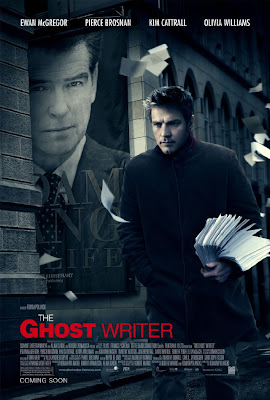
The Ghost Writer

The Ghost Writer movie review on NY Times
The Cricket only just now caught The Ghost Writer (2010) by Roman Polanski. It’s an interesting movie – and when saying “interesting” you may detect a hint of reservations. The story has ambitions that unfortunately remain unrealized. The unnamed eponymous ghost writer (Ewan McGregor) is hired to rewrite the memoirs of the former British Prime Minister Adam Lang (Pierce Brosnan) – a barely disguised stand-in for Tony Blair. Lang’s previous ghost writer just died from drowning under suspicious circumstances. When the writer moves from London to the U.S., where Lang is staying for a lecture tour (the town is a fictional Old Haven, on an island off Massachusetts, thus Martha’s Vineyard), a conspiracy slowly starts to unfold. Not only was the ghost writer’s predecessor murdered, Lang is accused of illegally extraditing terrorist suspects to the U.S. and faces possible war crime charges in The Hague. The writer discovers a connection between Lang and the CIA, involving a Cambridge classmate, Paul Emmett (Tom Wilkinson), who is now a Harvard professor. Additionally, it becomes clear that Lang is having an affair with his personal assistant Amelia Bly (Kim Cattrall), while his wife Ruth (Olivia Williams) grows evermore impatient at her husband’s unwillingness to take her advice as he used to. The ghost writer gets chased around and eventually contacts Lang’s former Foreign Minister Richard Rycart (Robert Pugh), who is now the U.N. envoy who accuses Lang of the illegal seizure of terrorist suspects.

The film – and the novel by Robert Harris on which it is based – poses some appropriate questions about the post 9-11 political landscape. Unfortunately, it never really explores these questions in any depth. It certainly is baffling that a Labour PM could have been such an American lapdog – especially at the time of the Bush administration. Adam Lang, however, remains a rather flat character, more of a womanizer and heavy drinker. We get no indication what motives him, why he is such a staunch pro-American, or what his thoughts are on the war on terror. We are led to believe that he merely became politically active through his wife Ruth, who was his trusted advisor for years. We get no indication either what motivates her, why she is throwing temper tantrums, or why she approaches the ghost writer for solace and sleeps with him. In the end, we learn that she has been a CIA agent from the start, recruited by Emmett, and thus her emotional instability becomes only more puzzling and her motivations even more obscure. There’s a hint at a rightist intellectual think-tank, Arcadia, with ties to the CIA and a weapons dealer in whose private jet Lang is flying. It is all tossed in our direction, perhaps even vindictively, for us to make sense of. But the moral quandaries, the fascinating grey area between good and bad, are left unaddressed. It is, for one, a government’s responsibility to protect its citizens, whether from terrorism or other menaces. How to implement national security without breaching human rights, international laws, and personal privacy, those are important questions from which this film shies away.

The Ghost Writer Even on the level of a thriller the movie falters. Polanski employs some of the usual ploys to create suspense: it rains a lot, skies are broodingly dark, much of the actions takes place on an isolated island, the ghost writer stays at an empty hotel, until a crowd of journalists and protesters swarm all over the place, Lang’s modern minimalist villa is menacingly impersonal; then there are the eerie strings on the soundtrack, the car chase, suspicious people in the background. The tension between the characters, however, could have been emphasized to greater advantage, and should have been the main focus. Cattrall’s Bly just stands there as Williams’ Ruth throws fits of frustration, while Brosnan’s Lang sits and looks on. The best scene, in terms of suspense, is carried by Wilkinson’s Emmett, fiddling nervously with his fingers while sternly rebutting the ghost writer’s insinuations. The penultimate scene in which the ghost writer passes on a note at the book presentation to confront Ruth about his discovery is utterly senseless – it fails as the final act and remains implausible from the ghost writer’s perspective (or we have to acknowledge that he is just plain stupid). To bring home the conspiracy hypothesis, the ghost writer gets run over while trying to escape with Lang’s original (coded) manuscript.

On a personal level, we might speculate that Polanski was driven to produce and direct an anti-American film. While editing the movie, he was himself under siege, i.e., under house arrest in Switzerland facing possible extradition on account of pending charges of sexual abuse going back over thirty years. Such a personal motivation may, in part, explain the rather one-sided perspective and why the moral dilemmas facing the various characters is so little explored. In the end, Adam Lang is no more than a mindless pawn in American imperialism, manipulated by his wife, both hungry for a figment of power and the easy comfort that comes with it. That is not to say that I personally condone the extradition of terrorist suspects so that they can disappear in detention camps until they confess under torture – or die. I do believe, however, that Polanski’s personal experience of facing extradition (in his mind, at least) on trumped up charges plausibly suggests that he sympathizes with the victims of Guatánamo Bay. Yet, America is not the embodiment of everything that’s wrong in this world. These are times in the grip of terrorism, which – whatever its motives or leanings – is easily identifiable as criminally evil. This film never addresses this side of the story, other than in politicians’ hollow sound bites. To your Chirping Cricket, that’s a missed opportunity.

Monday, November 29, 2010

Fright Nights

Catacombs, the movie, you don't want to see it!
Over the summer the Cricket spent a couple of nights with the kids watching some of the most atrocious horror garbage you should save yourself from even getting anywhere near to. They were that bad. So that you won’t make the same mistake, here we go. From the premise, you’d think Catacombs (2007) has the perfect setting for a Slayer video: subterranean cemetery below the streets of Paris: the realm of darkness underneath the City of Light. This empire of the dead is the last resting place of millions of skulls and bones, often artfully arranged in a labyrinthine structure of chambers and corridors some sixty feet underground. It is in this morbid maze that an unsuspecting naïf (Shannyn Sossamon) gets drawn by her abrasive sister (P!nk). I can already hear your eyes roll... The Second Act consists entirely of the girl running in the darkness to evade the clutches of some evil serial killer... No Third Act can make up for that, but this ending stank so bad, I won’t even begin to tell you. Awful!

Gene Simmons has a grandmother, too!Next, we have Buried Alive (2007) – even the title is a rip off. Here we’re dealing with some family curse and ghostly apparitions. The film is plagued by common horror tropes: college initiation insanity, gratuitous nudity, inexplicable acts of random violence, a curious family history, a road trip to a remote cabin, a frightfully misanthropic caretaker who enjoys stuffing dead animals, dysfunctional mobile phones, flying axes, power failures, sabotaged cars, and after everyone else is slaughtered, the two remaining teenagers are, of course, buried alive... yawn... I needn’t say more.

Gone to Ruins, get it?Lastly there’s The Ruins (2008), another stinker of a movie. Here we join two American teenage couples with some recent friends to the ruins of a Mayan temple in the remote Mexican jungle. Angry villagers kill off one of them fast. Atop the ruin their cell phones have no signal, but they can distinctly hear a cell phone ringing down the mineshaft. Naturally, as one of them is lowered down, he has a fall and breaks his back. They are able to get him out, but then next morning the vines that cover the ruin have eaten into the guy’s leg. Desperate to get to the cell phone in the shaft, the two girls go back down, only to find the dead body of the cell phone’s owner – and to learn it’s not the phone they hear ringing, put the vines! (?!?) You get the picture. They all die, but for one, who in the alternate ending still has vines crawling inside her. Yuck!

Monday, November 15, 2010

Danger After Dark II

Noriko’s Dinner Table movie review on NY Times
Noriko’s Dinner Table (2006) by Sion Sono is a companion piece to Suicide Club (2002). However, it’s neither a prequel nor a sequel. Noriko is an awkwardly shy town girl, desperate to break away from her boredom. Her only friends she meets online. In voice-over narrations she tells us how it is she came to Tokyo. When she first meets her online pal (about half an hour into the movie), you just know things are going to get seriously weird. The pal introduces herself as Kumiko. And just so you know we’re talking seriously messed up we flash forward straight away to half a year later when fifty four girls cheerfully jump in front of the 7:30 train at Shinjuku Station. Meanwhile, Noriko’s family has no clue where she is. Her sister Yuka is still in Yokohama, too, happily telling her boyfriend how her sister may have been one of the suicide girls, and that she knows how all the girls arranged to meet at the station. She shows him the screen with the red and white dots: red for female suicides, white for male. Suddenly the screen turns black with the text, “Am I connected with myself, Sis?” She leaves home, too, but leaving her father clues that he manages to put together: the Suicide Club does exist. For her part, Noriko idealized Kumiko’s happy family: they are connected and share their love at all times. She learns to connect with herself – and empathize with others. Kumiko works in “family rental” pretending to be some client’s family member for money. In his own search to find his daughters, Noriko’s father learns that he really is in search of himself. Like its predecessor, this film thus explores computer-age alienation, the loss of connectedness, and emotional isolation in modern urban society. If you were expecting another splatterfest, though, you will be disappointed as the movie is more of a psychological drama. It is also one of the rare occasions where the cinematographic effects (fast editing, dangling cameras, etc.) actually work well to convey the emotional landscape of the characters.

2LDK movie review on NY TimesAragami (2003) by Ryuhei Kitamura is the counterpart of Yukihiko Tsutsumi’s 2LDK (2002). This film, too, features mainly two actors battling, set within a single set, and was produced within one week. But that is where the similarities end. Interestingly, while the cinematography (as well as the continuous electronic pop rock synthesizer soundtrack) is decidedly modern, the story is set in a once-upon-a-time far-faraway, reminiscent of a traditional Japanese tale. A samurai regains consciousness in a remote mountain temple after falling at the entrance with life-threatening wounds. He learns that his companion did not survive, but the inhabitant of the temple invites him to stay and entertains him with a luscious meal, French wine and Russian vodka. He regales the samurai with frightful stories about Tengu (long-nosed mountain goblins) and Aragami, the Raging God of Battle. The samurai soon discovers that his wounds have all healed, but how? His host explains he gave him his friend’s flesh! But who is this host? He was once the legendary Miyamoto Musashi, the greatest warrior ever known, but now has become none other than Aragami himself! They duel, but even when Aragami runs his blade through the samurai’s stomach, it leaves only a scratch. His wounds heal due to the cannibalistic meal, but he is not immortal, as the head or the heart will kill him dead. Aragami has become weary of his existence and hopes this samurai will be the one to kill him honorably. Although the sword-fighting acrobatics are worth the watch alone, it’s the increasing psychological tension that makes this film a satisfying experience. Quite a feat considering the constrained conditions of two actors in a single set!

Glamorous Life movie review on NY TimesBefore we get to The Glamorous Life of Sachiko Hanai (2003) by Mitsuru Meike, it might be useful to first discuss (however briefly) the pinku eiga genre. Pinku eiga emerged in the 60s as a genre evading Japanese censorship laws by blocking or blurring genitals while maintaining a required minimum quota of sex scenes (some four or five per hour). Terms such as “soft-core” or “sexploitation” are somewhat misleading, as the genre often contains elements of action, thriller, violence, horror, and/or political commentary. In this case, the titular Sachiko Hanai is a role-play call girl specialized in playing home-tutoring. What sets the narrative is that Sachiko next gets hit by a bullet in the forehead while trying to take a picture of a shady business transaction running foul between a North Korean and Middle Eastern in a cafeteria. Miraculously, she survives, but the bullet lodged in her brain spurts her intelligence to ponder the abstract universe and subjective truth in mathematical equations. Plus, she can foresee future events, which involve sex and violence – and she finds she has a much delayed taste sensation. We are bombarded with musings about situationalism, rationalism and the Platonist view on Christianity, objective reality and Japan’s lack of a nuclear military strategy to match that of Russia or the U.S, all combined with sex (not the sensual erotic or even graphic pornographic kind, but of the prosaic, romping, five-minute sort – including six gallon ejaculations). Sachiko also discovers a silver cylinder containing a clone of George W’s finger. He appears to her in a reflection urging her to defend world peace and democracy. I’m sure you can guess where that finger is going. While she is climaxing, we are shown images of the U.S. invasion of Iraq, the toppling of Saddam Hussein’s statue, and of Bush inspecting his fleet. Meanwhile, the North Korean who shot her in the cafeteria hopes to retrieve Bush’s finger, for it controls nuclear Armageddon. In the end, after abstract infinity, cogito ergo sum, beef stew, dues ex machina, and more sex, Sachiko walks out of a primordial cave straight into nuclear obliteration. A must see!

Saturday, October 30, 2010

Planet Terror

Planet Terror movie review on NY Times
In the spirit of Halloween, the Cricket thought it would be appropriate chirping on some over-the-top zombie horror action flick, like Planet Terror (2007), Robert Rodriguez’ contribution to the Grindhouse double feature. This is a textbook example of disgusting sore and rotting gore, and an all-out splatterfest. Nothing spells over-the-top better than a former go-go dancer (Rose McGowen) with a machine gun for a prosthetic leg. Then there’s the botched military transaction with some Indian biochemist who likes to cut off testicles. A green fume is released, prisoners escape, and soon radioactive blistered zombies are attacking stranded damsels (including Fergie). We also have a paranoid doctor who is treating the affected townspeople – and who is suspecting his anesthesiologist wife of cheating on him (with Fergie! Nice. But she’s dead.) Before you know it all hell is breaking lose in all its fiery rampage. And amidst such terrifying insanity, the only natural thing to do is having sex. The faux-seventies air, with the weird new-age synthesizer soundtrack, is annoyingly distracting. Never mind it’s supposed to be a “tribute” to the grindhouse fare of yesteryears. The story obviously takes place in this millennium, what with the cell phones, rifles with night-goggles, video games, references to the “Food Channel,” Jesse James the motorcycle guy, and even Bin frikken Laden! It would have been fun if I could turn my brain off, but I’ve seen worse.

Monday, October 4, 2010

Danger After Dark

Suicide Club movie review on NY Times
Not too long ago, the Movie Cricket borrowed a box set of Japanese movies. The one that I really wanted to see again was Suicide Club (Jisatsu Sākuru, 2002). That film, directed by Sion Sono, opens with one of the most memorable cinematographic scenes you will ever see: young girls come walking down the stairs onto the train platform, in their school uniforms, they step up to the edge, hold hands, and on the count of three all fifty-four jump in front of the train together, blood and body parts gusting all over. With more and more suicides happening, the police are left clueless about their connection. Are they dealing with a cult, or a fad? In that respect, the story is a murder mystery, but one larded with tropes of the horror genre: rainy nights, dark and empty office building, curtains flowing in the breeze, power failure, splatter and gore, strips of human skin. Then there’s the all-girl idol-group Dessert, who sing about e-mails and jigsaw puzzles. Gradually things get more and more weird, to the point of a psychedelic trip into delirious hallucinations and delusions of glam-glitter grandeur. “I want to die as beautifully as Joan of Arc inside a Bresson film,” some psychotic freak sings, “Lesson one: apply the shaving cream – and smile as you then slowly slice away the heart.” In all, this is an exploration of isolation in urban Tokyo, of alienation in modern society; a social commentary of the dehumanization of online interacting and pop culture mass media; and about people finding meaningful relationships in committing mass suicide.

2LDK movie review on NY TimesNext up in the box comes 2LDK (2002), directed by Yukihiko Tsutsumi, about two roommates (played by the beautiful Eiko Koike and Maho Nonami). (The title is a classified ad abbreviation for a 2-bedroom apartment, with shared living room, dining room and kitchen.) One is a neat, reclusive country girl who only recently arrived in Tokyo; the other is a fabulous hip chick with money to burn on Gucci, Miu Miu, Chanel and Hermès. One is a well-educated lover of theater; the other is an air-head beauty pageant queen who began her acting career in porn. One plays classical piano; the other listens to heavy metal. (Guess who the Cricket was rooting for.) They find out that they are competing for the same lead role; the extrovert Lana taunts the introvert Nozomi about a man she has a crush on; but Lana is also jealous about Nozomi’s bigger breasts. In the close confinement of their apartment (the whole film is set within the titular 2LDK), their petty quarrels soon escalate from insecurities and envy to mutual murderous hatred. Thematically there are some parallels with Suicide Club, in that 2LDK also deals with isolation in urban Tokyo, but rather than turning that social seclusion inwards, this film unleashes the claustrophobic and paranoid violence outwards between the two young women. And that violent rivalry is brutally ugly. For a film shot on one set within a week with only two actresses, it is quite an achievement to keep the viewer engaged, but the performances, the dialog, and the cinematography and offering excellent, though gory, entertainment.

Moon Child on IMDBThe last movie of the set is Moon Child (2003), directed by Takahisa Zeze, and stars J-pop idols Hideto “Hyde” Takarai and Gakuto “Gackt” Kamui (who also co-wrote the script). This film is a futuristic science-fiction martial-arts gay-glam vampire organized crime action horror thriller comedy drama. It follows the life of orphaned Sho (Gackt) and his friends through the first half century of the 21st millennium, when Japan has suffered a major economic collapse and many people have taken refuge in the multi-ethnic “Asian Special Economic Zone” of Mallepa on mainland China. The Mallepa Orphans make their living through robbery and in so doing run into conflict with the Cantonese mafia. The orphans have one advantage, their guardian Kei (Hyde) who happens to be a vampire. Gradually the group of friends falls apart, while Kei is imprisoned. In essence, then, this is a story of love and friendship, the ties that bind. Kei provides the common trope in vampire stories, that is, the loneliness that comes with immortality as friends become mere drops in the ocean, tears in the rain, that wash away in the sad agelessness of the undead. Unfortunately the movie employs those musical interludes – when the writers have to move the story forward, but can’t write a script for the scene. The film also drags on for two full hours, resorts to the cheap and cheesy ploy of cancer to bring Kei and Sho together one last time, and ends with a dual suicide at sunrise. In all, it’s not an awful movie, but it isn’t one that comes with the Cricket’s chirpiest recommendation.

You may now find a follow up of sorts: Danger After Dark II!

[A special shout out goes to Anthony and Sander!]

Saturday, September 11, 2010

Inglourious Basterds

Inglourious Basterds movie review on NY Times
Apparently I am one of the few people who didn’t enjoy Quintin Tarantino’s Inglourious Basterds (2009). I am not a big fan of his films to begin with. This is another piece of genre blending filled with cinematic references, particularly to Sergio Leone and Ennio Morricone, what with the opening words, “Once Upon a Time ... in Nazi-Occupied France,” dramatic music based on the theme of “Für Elise,” a panoramic shot of the French countryside, then a close-up of a man’s face. I’m already annoyed. The various plots are frightfully contrived and the dialog is too smart for its own good. For no good reason, we get other references to WWII films, like Where Eagles Dare, some unnecessary Marvel Comics lettering, unwelcome voice-overs, Edith Piaf, Marlene Dietrich, Leni Riefenstahl, Max Linder, and on and on. The main story is an indulgence in an alternative reality, there are jokes about situations that aren’t funny, there is no moral core, violence is a means to solve problems, and Jews perpetrate atrocities as awful as their enemies. The characters remain flat – Brad Pitt’s First Lieutenant Aldo Raine is particularly distracting with his faux-Tennessee drawl jabbering about Nazzies. The only redeeming quality is Christopher Waltz’ performance as SS Colonel Hans Landa, who is fluent in German, French, English, and Italian, and has a knack of making polite conversation even when he’s interrogating. In brief, the movie is about two plots to eliminate the German high-command, including Hitler, Goebels, Göring and Bormann, while they attend a premiere at a Parisian cinema theater. And apart from Alder carving a swastika in Landa’s forhead, that’s it. The End. History has been rewritten.

Wednesday, August 4, 2010

The Box

The Box movie review on NY Times
The premise of The Box (2009) is fairly simple, as you probably know even if you haven’t seen the film: Would you accept a million dollars knowing that by accepting it you will cause the death of somebody, anybody else? It sounds simple enough. Most of us would probably say “yes.” But think of the altruism coefficient (or rather the opposite): if too many people are unable to sacrifice their individual desires, humankind would not survive. That is the message that comes late in the movie. Few of us can see beyond the temptations dangling in front of us and cannot foresee the consequences of our actions. Profound as that sounds, it is at this point that the film unfortunately fails – offering no other resolution than the rather Stoic moral of resisting temptations. In that respect, the movie smacks of Puritan Protestantism. Nevertheless, the story is a real thriller with a dash of science fiction and a hint of horror – and it is unsurprising that the short story on which the film is based (“Button, Button” by Richard Matheson) has also been adapted for The Twilight Zone.

The Lewis family receives a box with a red button under a glass hemisphere and a note that Mr. Steward will call upon them that afternoon. Arthur Lewis (James Marsden) works for NASA, where he developed a 360-degrees camera, but is notified that his application for the astronaut training program is rejected. His wife Norma (Cameron Diaz), a private high school teacher, is informed that faculty will no longer get a tuition waiver for their children. With these setbacks fresh on their minds, Mr. Steward’s offer of a million dollars is a tantalizing temptation. They have one day to make their decision – and after much deliberation, Norma pushes the box’s button to accept the money. Steward arrives to deliver the cash and retrieve the box. He tells them it will be reprogrammed but they do not know the person who will next receive the same offer. Meanwhile, NASA employee Jeffrey Carnes has shot his wife point blank. From that moment, events take weirdly mysterious turns in their life. People show up with secret messages and nosebleeds. Steward seems to know their every move.

The Box movie review by Roger EbertIt is 1976, Lynyrd Skynyrd is at the height of their fame, President Ford is on television, and the Viking mission is broadcasting images from Mars leading to speculations about life on Mars. Arlington Steward (Frank Langella), it transpires, was once hit by lightning while working at NASA’s Langley Research Center. Considered dead, he revived, regenerated at ten times the normal speed, his cell degeneration halted (implying he no longer ages), but his face still displays a scar the shape of the Face on Mars. He is now a vessel for “those who control the lightning” – apparently divine or extraterrestrial beings who are putting humankind to some twisted test. There are references to salvation and eternal damnation, to Sartre and 70s culture in America. There are drones moving like zombies who apparently do Steward’s bidding. With all these conspiracies, plot twists and complications abounding it is disappointing that so many threads remain dangling at the end. With a different ending, I would have said it’s a good movie, but as it is I felt we were bombarded with questions but received unfortunately few answers to anything.

Tuesday, July 20, 2010

The Host

Your Chirping Cricket was recommended to watch The Host (Gwoemul, 2006), the highest grossing film in South Korea. In the horror genre, this is a great monster movie, with a sense of humor and an actually sensible plot. The story revolves around a rather dim-witted man who loses his daughter to an amphibian monster from the Han River. Believing she has died, he grieves with his father, brother and sister. On the last battery power of a cell phone, she calls to tell she is somewhere in a big sewer. The remainder of the film, we follow the family in their chase to find her, while they break out of quarantined hospitals, obtain a truck and a map of the sewerage system with the family’s savings, and attack the monster. It kills the grandfather and the three siblings get separated. The brother is able to trace the girl’s call to the north side of Wonhyo Brigde, but he is betrayed by people who are chasing him for reward money. Meanwhile the young girl remains trapped in the monster’s lair with other victims. The only other one alive in the pit is a homeless kid who is even more scared than her. She tries to climb out by making a rope of clothes, but it catches her again with its tail and then gulps her and the kid in its ferocious mouth.

At this point, Seoul is in uproar as the government has decided to employ Agent Yellow to eradicate the monster and the deadly virus of which it is supposedly the host. The monster attacks the protesters but is incapacitated by the chemical fumes. The three siblings reunite and the girl’s father takes his chance to pull out his daughter as well as the little kid from the monster’s hideous mouth. She has suffocated despite holding on to one of the monster’s teeth. In his anger the father attacks the monster with a street pole, but all that achieves is that it wakes it up. The brother attacks it with fire bombs made of soju bottles. Then a homeless man pours gasoline over the monster, and the sister, a national arching medalist, shoots a flaming arrow into its eye, while the girl’s father rams the pole through its mouth and pierces its brain. With the monster dead, he checks on the little kid and finds that he is still alive. He decides to adopt him as he was with his daughter in the monster’s pit. Months later, when they are having dinner, the news on the TV announces in the background that the “disease crisis” was a case of “misinformation.” They just turn it off.

In fact, we knew from the beginning that the monstrous creature was a mutant amphibian caused by deliberate formaldehyde spillage into the Han River. And that is the running political commentary in this film. For it was an American military pathologist who ordered the formaldehyde to be dumped down the drain; it was the American military that quarantined everyone who got near the monster because of a deadly virus that never existed, and then ordered to perform a frontal lobotomy on the girl’s father; and it was the American military that employed Agent Yellow (a thinly veiled reference, of course, to Agent Orange). The monster, in other words, is a metaphor for America’s military presence in South Korea, and the family’s resilience is an ode to self-reliance and national sovereignty. The monster itself is quite a marvel of a mutant hybrid, with its elegant acrobatics, its clumsy legs, its ugly jaws and frightful tail. Interesting, too, is that the monster creature appears almost at the beginning, unlike in so many other films of the “creature from the deep” genre. The film is not screaming bloody gore, it has intelligent drama at the heart of the story, and the action scenes are highly entertaining. You might want to watch it, too.

Thursday, July 8, 2010

Alice in Wonderland

I’m probably the last person on earth to watch Tim Burton’s Alice in Wonderland (2010) one of the world’s highest grossing box office movie successes. So, it’s probably redundant to offer much of a plot synopsis. The dream story is framed by Alice’s real life in Victorian England, where she’s faced with society’s expectations of a nineteen-year old girl. The fabulously fantastic events that unfurl after falling down the rabbit hole are in essence a girl’s quest to find herself, or, her “muchness” in the story’s parlance – not to be too small and not too tall, know right from wrong, face her demons, befriend the Bandersnatch, not to live her life pleasing others, imagine six impossible things before breakfast, slay the Jabberwock on frabjous day, and find her way back home. Callooh! Callay! It’s a story to which we can all relate, because we are all on a quest to find ourselves amidst society’s expectations. I’m impressed that Burton and his writers created an actual story from Carroll’s source material of deliberately unrelated nonsensical yet funny events. It smacks a little too much of modern female empowerment, but you might say that makes the story more relevant – just as the rebellion against terrorizing tyranny has a contemporary ring to it.

The fantastical landscape, while Disneyfied, remains recognizably Burton – and in a way is a character all by itself. It lives, sometimes literally, in the sense that for instance the Red Queen’s palace is filled with animals functioning as furniture. However, the main characters themselves are what make the film. Mia Wasikowska’s performance as Alice has just the right combination of naïveté and determination for the part. Johnny Depp seems to be stuck in acting weirdos (Jack Sparrow, The Libertine, Willy Wonka, Sweeney Todd, etc.) – to the point of getting predictable. Here, his Mad Hatter Tarrant Hightopp has an interesting blend of craziness and sadness, but I found his flow of accents rather annoying. Supposedly, that was meant to reflect the character’s moods, but it hardly came through – at least not for me. Helena Bonham Carter’s Red Queen was, on the contrary, spot on: a spoiled toddler with absolute power to make everyone’s lives miserable. Anne Hathaway as the White Queen seemed entirely miscast. I can’t tell what they were going for, but she has little in common with Carroll’s illogical, absentminded White Queen who lives her life in reverse and thus can remember future events. I would have wished that Crispin Glover’s Knave of Hearts was more evil, instead of such a spineless weasel.

For Carroll die-hards there are several irks, too. I’m not saying that I’ve caught them all, but, to give you an example, “Jabberwocky” is the name of a poem about the Jabberwock (without the –y suffix), “with eyes of flame,” that “came whiffling through the tulgey wood, and burbled as it came!” Depp mispronounces “borogoves” as “borogroves” (with an additional –r- in groves). Similarly, I was surprised by the pronunciation of “upelkuchen” like “uppelkutshen” (which sounds like the Dutch word “huppelkutje” that I best not translate), while “kuchen” must have been borrowed from the German word for cake (pronounced “kookhen, [kuːxən]),” with a velar fricative like the Spanish j or the English “loch”). In all, I am left with mixed feelings. Some aspects were enjoyable: the story itself was entertaining, some of the performances were good, and they did honor to the original without sticking too closely to Carroll. Yet I do have qualms about other aspects: the story lost some of the absurdity of the original, the animations didn’t mash too well with the real life actors, and some performances were fairly lame. It’s not a film I would enthusiastically recommend, but then again, everybody else has already seen it.

Wednesday, June 23, 2010

Pi

In the genre of weird movies, there’s also π (1998) by Darren Aronofsky (who also directed Requiem for a Dream). The story’s main character, Max Cohen, believes that everything in the universe adheres to patterns that can be understood through numbers. At first he’s using his self-made supercomputer to predict the stock market. But then he meets a zealous Hasidic Kabbalist who hopes to decipher god’s code in the Torah through numerical calculations. At the same time, Max has been approached by a Wall Street firm, who offer him a superchip in return for his predictions. His computer prints out a string of 216 numbers, just like his old computer did before breaking down, just as his math mentor had just before he died, and through some epiphany he recognizes the spiral-shaped patter in the number-string. The Kabbalist and the Wall Street firm increase their pressure on Max, which sends him over the edge of sanity.

The film toys with the thin line between genius and insanity – the maddening truth, the truth in madness, like an Arthur Machen story, or a Terry Gilliam film. Perhaps the most profound statement in the movie is the mentor’s admonition, that “as soon as you discard scientific rigor, you are no longer a mathematician, you’re a numerologist.” This film is no advocate for scientific truths, though, as Max suffers from incapacitating migraines, nosebleeds, crippling hallucinations, paranoia, and possibly schizophrenia. In the end he drills a hole in his skull to be at peace – and never again think about numbers and patterns. Apart from the art-house hip black-and-white and the interesting soundtrack, I found the cinematography terribly annoying – what with the handheld shots, the quick cuts, and the extreme close-ups. Nevertheless, for those who wish to contemplate the ultimate truth – and whether to find it through science or mysticism – this may not be the worst way to spend your time.

Wednesday, June 16, 2010

New Rose Hotel

I doubt many people ever saw Abel Ferrara’s New Rose Hotel (1998), some kind of cyberpunk erotic thriller, starring Christopher Walken, William Dafoe, and Asia Argento. Care to know what cyberpunk is, perhaps? It’s another excuse for soft-core porn. Not that there’s anything wrong with girls getting naked – in this case Argento and a whole slew of anonymous Asian chicks. But shall I just come out and call a spade a spade? This film is bull-shit. The set up is actually interesting enough: two corporate raiders are promised $100 million if they kidnap a top genetic scientist from a rival company; in their ploy the two use an Italian Shinjuku call-girl to seduce the scientist into defecting.

If my initial enthusiasm was tepid, my interest waned fast, as the film grew ever more turgid. What should have been the thrilling dramatic climax, was nothing but dull fizz: the scientist and his new colleagues are killed by a lethal virus. The worst part was that after sitting through this horse manure for an hour, the film literally started repeating itself, tossing random scenes our way from the first two-third, adding more lurid sex for good measure. We learn that Argento’s call girl was never a pawn in the game of the two men, that in fact she seduced Dafoe’s character, and that she carried to information to reprogram the lab’s DNA synthesizer. Blahdeeblah ... yawn ... Can I go now? My popcorn turned stale.

Wednesday, June 9, 2010

Trainspotting

Since I watched Requiem for a Dream again the other day, I thought I might as well catch Trainspotting (1996), too, finally. I can’t tell why I never did before... Anyway, the film opens with a profound question: why choose all the conventional comfortable con- veniences of commercialized com- modities, of capitalist consumerism? Why be like everybody else? Don’t be. Why? There are no reasons. Now that’s deep; that’s me, in a nutshell: a non- conformist. But beyond that, don’t worry, I’m not a heroin addict, nor do I look like Ewan McGregor. So the similarities end right there.

Through the eyes of McGregor’s character “Rent Boy,” we follow a group of friends in 80s recession Edinburgh, some of whom are heroin addicts, while others are openly critical about doing drugs. Soon, Rent Boy tries to quit cold turkey. Later, when they’re hanging out at a bar, his sociopathic buddy Begbie causes a violent brawl. Then they go clubbing, Rent Boy falls in love, and whaddaya know, Blondie’s on the soundtrack. (Oh, the irony, but don’t worry if you didn’t catch that one – inside joke.)

Conventional life quickly becomes boring. So, Rent Boy and his friends start using again – anything they can get their hands on. And even clean kid Tommy (actor Keven McKidd, who we now know and love as Lucius Vorenus) starts using, because his girlfriend dumped him. Things start to unravel fast. A baby dies of neglect – one of the guys, Sick Boy, was probably the father. Rent Boy and his buddy Spud get arrested. Spud has to go to prison, Rent Boy goes into a rehabilitation program. But not for long, because he overdoes. His parents decide to lock him up in his room where he suffers from severe hallucinations. And (another insider) right when Rent Boy hit rock bottom, Lou Reed plays “A Perfect Day”! (Man, did they make this movie especially for me? Great soundtrack: Iggy Pop, Eno, New Order, Blur, Pulp, sheez!)

Meanwhile, Tommy has contracted HIV. Rent Boy tries to leave his mates behind and moves to a yuppie real estate gig in London. But before he knows it his friends catch up with him. Begbie shows up hiding from the police for robbing a bank. Sick Boy arrives, too, living off Rent Boy. Then Tommy passes away. Back in Scotland, the remaining friends decide to buy two kilos of heroin and sell it in London for a huge profit. Begbie spoils the party with yet another violent brawl. Rent Boy steals the money off Begbie, leaving some for Spud in a locker, and decides to opt for the conventional life he derided at the onset of the film.

While the film grabs the viewer’s attention with coarsely humorous and criminally violent scenes, dismally horrifying and repulsively disgusting scenes – sometimes all at once – what gives it emotional depth is the bond among the friends. They’re partners in crime. It’s a buddy flick – about guys who happen to be substance abusers. There’s an open ending, but it’s not a Hollywood Happy Ending. From Rent Boy’s previous attempts, we know he will come full circle again. He will fall back into his habit. That seems, to me at least, the message of the episodic and fragmentary narrative, that there are ups and downs, moments of clarity in the drug-infused haze, attempts to stay clean, but eventually the addiction will take over again – all it takes is one shot. This isn’t an anti-drug movie by any stretch of the imagination, but neither is it a pro-drug movie. Set among crime-infested urban poverty, this is social criticism. The heroin high is the one thing that makes them feel fine for a while, until they feel even worse – and then the buddies are there to go out and score some more, until they die.

Wednesday, June 2, 2010

The Isle

A while ago I saw another one of those weird movies, The Isle (Seom, 2000), a Korean, psychological horror flick by Kim Ki-duk. The setting is a poetically ethereal lake, a remote fishing resort with small floating cottages on the water. A mute Hee-jin ferries her customers back and forth, providing them with baits, supplies, hookers, and occasional sexual favors of her own. It certainly helps that she vaguely reminds me of my ex Paula (but I guess you’re tired of hearing me say that by now – and rightly so). The lyrical serenity of the scenery offers a stark contrast with the psychological and physical horrors that ensue. Hee-jin exhibits some kind of extreme bipolarism, showing dispassionate acts of kindness one moment, and demonstrating acts of gruesome cruelty the next. She slowly becomes intrigued with one of her customers, who’s suicidally depressed and on the run for the law. She saves his live one time, refuses his violent advances, calls in a girl for him, but then grows a passionate jealousy for the hooker. Eventually, Hee-jin ties the girl up and tows in her one of the floats to the farthest side of the lake. In her attempt to catch someone’s attention, the girl accidentally drowns in the water later.

Like the scenery, the iridescent cinematography contrasts severely with the torturous brutality appearing right in front of us. Acts of animal cruelty are depicted in the same unmoving stillness as scenes of rape, mutilation, attempted suicide and murder. The most excruciatingly troubling moments involve two complementary attempted suicides. In the first, Hee-jin’s lover swallows half a dozen fishhooks and has to be saved from the water by Hee-jin pulling the fishing line that’s stuck in his throat. She carefully pulls out the fishhooks, and then has sex with him to distract him from the bleeding pain. When the guy later tries to leave her, she imitates him, by inserting fishhooks into her vagina and falling in the water. She, too, needs to be towed out of the water by the fishing line caught inside her, and then the guy has to carefully remove the hooks while blood flows all over the float. The film ends enigmatically, after police officers discover the body of the hooker and her pimp, who Hee-jin had killed. She takes off with the guy on his float and they hide out in a patch of reeds...

The gory aesthetics of The Isle work on many different levels. The gruesome cruelty reveals primal instincts of basic human and animal emotions. Human relations are no more than fish caught in bait and eaten raw. It’s an allegory of extremes, like the serenity contrasting with the horror, where the shore and the floats represent life and death, love and hate, where sex can be as meaningless as eating fish or releasing oneself, or be as passionately primal as the struggle for life, the all devouring desire for connectedness in a remote lake of isolated isles between misty mountains. The poetics may be violent, but they serve a distinct purpose. The image of a dangling fish recalls the miniature of a hanging man that Hee-Jin’s lover made out of wire, which itself recalls Hee-jin enjoying her swing in front of her store overlooking the lake. Such intricate imagery makes this film a quietly disturbing, but delicately profound contemplation. If you have the stomach, you might enjoy The Isle, too.

Monday, May 24, 2010

Requiem for a Dream

I don’t care what you say, I think Requiem for a Dream (2000) is a terrific film – a terrible trip into drug-induced nightmares, but a good movie. True, I don’t care much for the cinematography, the split-screens, extreme close-ups, time-lapse scenes, and body-cam shots, or the quick-cut montage shots of drug use (dilation of pupils, pill swallowing, heroin cooking, etc. etc.). I understand that the style is meant to visualize the character’s isolation, alienation, to draw us into their subjective experience, but in my view the film would have done better without. At any rate, the story is about Harry (Jared Leto), his mother Sara (Ellen Burstyn), his girlfriend (Jennifer Connelly) and his best friend Tyron (Marlon Wayans). They all live in Brighton Beach, N.Y. Harry and his friends are heroin addicts who start pushing drugs on the street, hoping to help Marion open her own fashion store. Harry’s mother is a TV junkie addicted to infomercials. All alone, her life regains new meaning when she receives an invitation to participate on a game show. She goes on a diet, taking weight-loss pills, uppers and downers, gradually losing grip on reality. She begins hallucinating about food, the fridge starts moving, pastry starts flowing around the house.

Months pass and Sara never hears another word about the game show. In her desperation she increases her dosage, soon taking pills randomly. She believes Harry has found well-paying employment and will soon marry Marion; he gives her a new TV set; and soon she believes she’s the central character in her favorite infomercial. Tyron gets arrested in the middle of a gang assassination and Harry needs to use most of their earnings to bail him out. Drugs become scarce because of the gang violence. Marion is pushed into prostituting herself to make at least enough money to support their addictions. If things appeared to be fine in the summer but started to go badly by the fall, when winter hits they really descend into a nightmarish abyss. Sara completely loses it and ends up wondering the streets until she arrives at the TV studio. She ends up in a mental hospital, where they eventually resort to electric shock therapy when all else fails to get her better. Harry and Tyron drive away toward Florida hoping to score enough dope to sell back in New York, but on the way Harry’s arm gets more and more infected from shooting up. When Tyron takes Harry to a hospital to have his arm treated, they get arrested instead. Marion slides deeper into prostitution, performing perverse acts at an orgy full of men in suits. Tyron faces racism and forced labor in prison. Harry’s arm has to be amputated to save his life. The film ends with scenes of all four characters falling asleep in fetal position.

“Requiem for a Dream” is a beautiful title. A “requiem” is normally an elegy or ode sang at the funeral of a deceased. The deceased in this case being the dreams of the four characters. – Requiem aeternam dona eis, Domine (“Grant them eternal rest, O Lord”) – While we’re given some impression of these American Dreams, the movie rather depicts the character’s plunge into the nightmare, their descent into the abyss. The film is actually more critical of American consumerism than of drug use; it doesn’t scream: “Drugs Are Bad!” Nor would I judge anyone giving in to the temptations of food and drink, sex and drugs, or rock and roll – the pursuit of happiness. It’s when the addiction takes over, when we lose control, that we run the risk of losing ourselves and our minds. What director Darren Aronofsky illustrates admirably with this story (based on the novel by Hubert Selby jr.) is that the descent is so gradual it’s indiscernible – it’s impossible to tell at what point they have lost grip, when the rot has set in, and the fall has become inevitable. Because the story is so compelling, the dialogue and acting so enthralling, that I found this nightmare such a rush to watch. I recall when I first walked out of the cinema ten years ago, the experience left me shocked and repulsed, fascinated and high.

Monday, May 17, 2010

The Scent of Green Papaya

It’s been a long time ago since I saw the Oscar-nominated & Cannes prize-winning) film The Scent of Green Papaya (L'Odeur de la Papaye Verte, 1993) in the theater. So, I’m glad I caught it again a while ago. It’s directed by Anh-Hung Tran and stars his wife Yen-Khe Tran Nu. The plot revolves about a young peasant girl, Mui, who is hired as a servant in a shopkeeper’s family in Saigon. We’re made clear that it’s 1951, i.e., time of the First Indochina War – and throughout we hear sirens announcing the curfew and airplanes flying overhead. Mui performs her chores diligently and obediently; she’s inquisitive, taking in everything around her – the sounds of birds and insects, the music made around the house, the smell of food and the scent of the green papaya growing on the tree in the courtyard; she keeps two crickets in a little bamboo cage as pets; and she silently endures continuous taunts by the family’s youngest son. On the surface, the story is tranquil, scenes take their time, the camera lingers on plants, fruits and leaves, insects, toads and birds. The first half hour is merely introductory, getting to know who’s who.

But the tension and violence that we hear in the air also makes its way into the home. The boys torture ants and lizards; the grand-mother continually prays in mourning for the loss of her husband and her granddaughter (who would have been Mui’s age); the father has a habit of leaving without a trace for days or weeks, taking with him the family money; the mother tells Mui she is like a daughter to her (yet keeps her as a servant). Then the husband is found dead. Gradually the mother has to sell more and more possessions as they cannot make sufficient money selling cloth at the shop on the street side of the house. Women in this film suffer in silence. The music is incredible, it’s often hard to tell if we are listening to someone playing around the house or if it’s the supporting soundtrack; sometimes cellos mimic the planes in the air, or violins imitate the curfew sirens. And so the silent tranquility interweaves with the violent undercurrent within the family and outside in Vietnam.

Ten years later, 1961, Mui (now 20) is sent to work for a family friend as they can no longer support her. Mui has admired him all these years. He’s a trained pianist and about to be engaged to a woman who’s the only modern individual in the story: she a frivolous trollop; not much of a poster-girl for liberated Vietnamese women. Soon the man is drawn to Mui, breaks off with his fiancée and begins a relationship with Mui. He teaches her to read and write, and soon Mui is pregnant with child. To me, the ending is as abrupt as it’s unsatisfying... It’s almost tagged on as an afterthought. The romanticized view of women sympathizes with their silent suffering, but the only alternative, a Westernized modern woman, flutters by like a pesky nuisance. Men are even more distant and one-dimensional. We never learn why the father kept leaving home with all the money, his sons just pass by, torturing insects or bothering Mui, and the man Mui eventually marries (well, I’m assuming the marry) remains a mystery: we only know that he plays piano handsomely. So we are left wondering what drew them together, other than that they are painfully attractive and charming. Despite all these complaints, I honestly think this is well worth your trouble watching.

Saturday, May 8, 2010

Eat Drink Man Woman

I found that a much more interesting movie than The Cook, the Thief, His Wife and Her Lover, is Ang Lee’s Eat Drink Man Woman (1994). Of course, of course, attractive Taiwanese women ... I get it! But that’s not the sole or even primary reason. This movie is charming because of the simple yet effective story of a father, his three daughters, and their relationship with, and through, food. The father is a semi-retired master chef, who lost his wife sixteen years ago. His oldest daughter is a high school teacher who spent the past nine years nursing a broken heart. The middle daughter is a successful business woman who recently bought an apartment and then got offered a job in Amsterdam. The youngest of the three is a twenty-year old working the counter at Wendy’s. At the beginning of the story all three women still live at home, complaining about their father’s elaborate Sunday dinner banquets as if it’s a form of torture. First the youngest suddenly finds a boyfriend, gets pregnant, marries and moves out. Soon the eldest follows, finding a man to marry and move in with. The middle daughter considers staying at home to care for their father. But then things take an unexpected turn. And with such a beautifully simple story, and wonderful acting, you get a remarkably satisfying movie experience!

Sunday, May 2, 2010

The Cook, the Thief, His Wife & Her Lover

A movie I have been meaning to see for twenty years, but never got ‘round to, because I always forgot and didn’t really know what it was about ... is Peter Greenaway’s 1989 film The Cook, the Thief, His Wife & Her Lover (resp. played by Richard Bohringer, Michael Gambon, Helen Mirren and Alan Howard). Visually, the movie is a lavish and grand spectacle: the cinematography, the sets, the décor, the food displays, and the costumes designed by Jean-Paul Gaultier. (Every set has its own color, and costumes change in color along with the sets: blue outside, green in the kitchen, red in the restaurant, white in the restroom, brown in the bookshop.) I cannot say I’m a big fan of the score composed by Michael Nyman... It’s all very theatrical and formalist, but tedious as a result. Most annoying is the titular thief who has a violent oral fixation of Freudian proportions and who just keeps jabbering on and on about how brilliant he is, and how stupid everybody else is. It’s already terribly annoying after five minutes, but alas we have to endure his boorish bawls throughout ... practically on end... You can essentially guess the plot just from the title: the wife of a thief is having an affair in the cook’s restaurant, and then the thief finds out... Food, sex, and violence; life, love, and death... Hmmm... what was all the fuss about? Pray tell.