Showing posts with label Thriller. Show all posts

Sunday, March 13, 2011

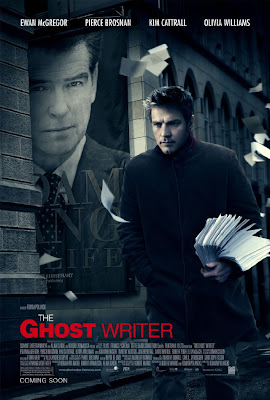
The Ghost Writer

The Ghost Writer movie review on NY Times
The Cricket only just now caught The Ghost Writer (2010) by Roman Polanski. It’s an interesting movie – and when saying “interesting” you may detect a hint of reservations. The story has ambitions that unfortunately remain unrealized. The unnamed eponymous ghost writer (Ewan McGregor) is hired to rewrite the memoirs of the former British Prime Minister Adam Lang (Pierce Brosnan) – a barely disguised stand-in for Tony Blair. Lang’s previous ghost writer just died from drowning under suspicious circumstances. When the writer moves from London to the U.S., where Lang is staying for a lecture tour (the town is a fictional Old Haven, on an island off Massachusetts, thus Martha’s Vineyard), a conspiracy slowly starts to unfold. Not only was the ghost writer’s predecessor murdered, Lang is accused of illegally extraditing terrorist suspects to the U.S. and faces possible war crime charges in The Hague. The writer discovers a connection between Lang and the CIA, involving a Cambridge classmate, Paul Emmett (Tom Wilkinson), who is now a Harvard professor. Additionally, it becomes clear that Lang is having an affair with his personal assistant Amelia Bly (Kim Cattrall), while his wife Ruth (Olivia Williams) grows evermore impatient at her husband’s unwillingness to take her advice as he used to. The ghost writer gets chased around and eventually contacts Lang’s former Foreign Minister Richard Rycart (Robert Pugh), who is now the U.N. envoy who accuses Lang of the illegal seizure of terrorist suspects.

The film – and the novel by Robert Harris on which it is based – poses some appropriate questions about the post 9-11 political landscape. Unfortunately, it never really explores these questions in any depth. It certainly is baffling that a Labour PM could have been such an American lapdog – especially at the time of the Bush administration. Adam Lang, however, remains a rather flat character, more of a womanizer and heavy drinker. We get no indication what motives him, why he is such a staunch pro-American, or what his thoughts are on the war on terror. We are led to believe that he merely became politically active through his wife Ruth, who was his trusted advisor for years. We get no indication either what motivates her, why she is throwing temper tantrums, or why she approaches the ghost writer for solace and sleeps with him. In the end, we learn that she has been a CIA agent from the start, recruited by Emmett, and thus her emotional instability becomes only more puzzling and her motivations even more obscure. There’s a hint at a rightist intellectual think-tank, Arcadia, with ties to the CIA and a weapons dealer in whose private jet Lang is flying. It is all tossed in our direction, perhaps even vindictively, for us to make sense of. But the moral quandaries, the fascinating grey area between good and bad, are left unaddressed. It is, for one, a government’s responsibility to protect its citizens, whether from terrorism or other menaces. How to implement national security without breaching human rights, international laws, and personal privacy, those are important questions from which this film shies away.

The Ghost Writer Even on the level of a thriller the movie falters. Polanski employs some of the usual ploys to create suspense: it rains a lot, skies are broodingly dark, much of the actions takes place on an isolated island, the ghost writer stays at an empty hotel, until a crowd of journalists and protesters swarm all over the place, Lang’s modern minimalist villa is menacingly impersonal; then there are the eerie strings on the soundtrack, the car chase, suspicious people in the background. The tension between the characters, however, could have been emphasized to greater advantage, and should have been the main focus. Cattrall’s Bly just stands there as Williams’ Ruth throws fits of frustration, while Brosnan’s Lang sits and looks on. The best scene, in terms of suspense, is carried by Wilkinson’s Emmett, fiddling nervously with his fingers while sternly rebutting the ghost writer’s insinuations. The penultimate scene in which the ghost writer passes on a note at the book presentation to confront Ruth about his discovery is utterly senseless – it fails as the final act and remains implausible from the ghost writer’s perspective (or we have to acknowledge that he is just plain stupid). To bring home the conspiracy hypothesis, the ghost writer gets run over while trying to escape with Lang’s original (coded) manuscript.

On a personal level, we might speculate that Polanski was driven to produce and direct an anti-American film. While editing the movie, he was himself under siege, i.e., under house arrest in Switzerland facing possible extradition on account of pending charges of sexual abuse going back over thirty years. Such a personal motivation may, in part, explain the rather one-sided perspective and why the moral dilemmas facing the various characters is so little explored. In the end, Adam Lang is no more than a mindless pawn in American imperialism, manipulated by his wife, both hungry for a figment of power and the easy comfort that comes with it. That is not to say that I personally condone the extradition of terrorist suspects so that they can disappear in detention camps until they confess under torture – or die. I do believe, however, that Polanski’s personal experience of facing extradition (in his mind, at least) on trumped up charges plausibly suggests that he sympathizes with the victims of Guatánamo Bay. Yet, America is not the embodiment of everything that’s wrong in this world. These are times in the grip of terrorism, which – whatever its motives or leanings – is easily identifiable as criminally evil. This film never addresses this side of the story, other than in politicians’ hollow sound bites. To your Chirping Cricket, that’s a missed opportunity.

Monday, November 29, 2010

Fright Nights

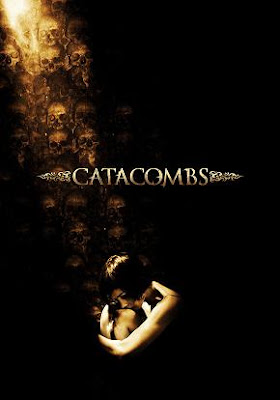
Catacombs, the movie, you don't want to see it!
Over the summer the Cricket spent a couple of nights with the kids watching some of the most atrocious horror garbage you should save yourself from even getting anywhere near to. They were that bad. So that you won’t make the same mistake, here we go. From the premise, you’d think Catacombs (2007) has the perfect setting for a Slayer video: subterranean cemetery below the streets of Paris: the realm of darkness underneath the City of Light. This empire of the dead is the last resting place of millions of skulls and bones, often artfully arranged in a labyrinthine structure of chambers and corridors some sixty feet underground. It is in this morbid maze that an unsuspecting naïf (Shannyn Sossamon) gets drawn by her abrasive sister (P!nk). I can already hear your eyes roll... The Second Act consists entirely of the girl running in the darkness to evade the clutches of some evil serial killer... No Third Act can make up for that, but this ending stank so bad, I won’t even begin to tell you. Awful!

Gene Simmons has a grandmother, too!Next, we have Buried Alive (2007) – even the title is a rip off. Here we’re dealing with some family curse and ghostly apparitions. The film is plagued by common horror tropes: college initiation insanity, gratuitous nudity, inexplicable acts of random violence, a curious family history, a road trip to a remote cabin, a frightfully misanthropic caretaker who enjoys stuffing dead animals, dysfunctional mobile phones, flying axes, power failures, sabotaged cars, and after everyone else is slaughtered, the two remaining teenagers are, of course, buried alive... yawn... I needn’t say more.

Gone to Ruins, get it?Lastly there’s The Ruins (2008), another stinker of a movie. Here we join two American teenage couples with some recent friends to the ruins of a Mayan temple in the remote Mexican jungle. Angry villagers kill off one of them fast. Atop the ruin their cell phones have no signal, but they can distinctly hear a cell phone ringing down the mineshaft. Naturally, as one of them is lowered down, he has a fall and breaks his back. They are able to get him out, but then next morning the vines that cover the ruin have eaten into the guy’s leg. Desperate to get to the cell phone in the shaft, the two girls go back down, only to find the dead body of the cell phone’s owner – and to learn it’s not the phone they hear ringing, put the vines! (?!?) You get the picture. They all die, but for one, who in the alternate ending still has vines crawling inside her. Yuck!

Monday, November 15, 2010

Danger After Dark II

Noriko’s Dinner Table movie review on NY Times
Noriko’s Dinner Table (2006) by Sion Sono is a companion piece to Suicide Club (2002). However, it’s neither a prequel nor a sequel. Noriko is an awkwardly shy town girl, desperate to break away from her boredom. Her only friends she meets online. In voice-over narrations she tells us how it is she came to Tokyo. When she first meets her online pal (about half an hour into the movie), you just know things are going to get seriously weird. The pal introduces herself as Kumiko. And just so you know we’re talking seriously messed up we flash forward straight away to half a year later when fifty four girls cheerfully jump in front of the 7:30 train at Shinjuku Station. Meanwhile, Noriko’s family has no clue where she is. Her sister Yuka is still in Yokohama, too, happily telling her boyfriend how her sister may have been one of the suicide girls, and that she knows how all the girls arranged to meet at the station. She shows him the screen with the red and white dots: red for female suicides, white for male. Suddenly the screen turns black with the text, “Am I connected with myself, Sis?” She leaves home, too, but leaving her father clues that he manages to put together: the Suicide Club does exist. For her part, Noriko idealized Kumiko’s happy family: they are connected and share their love at all times. She learns to connect with herself – and empathize with others. Kumiko works in “family rental” pretending to be some client’s family member for money. In his own search to find his daughters, Noriko’s father learns that he really is in search of himself. Like its predecessor, this film thus explores computer-age alienation, the loss of connectedness, and emotional isolation in modern urban society. If you were expecting another splatterfest, though, you will be disappointed as the movie is more of a psychological drama. It is also one of the rare occasions where the cinematographic effects (fast editing, dangling cameras, etc.) actually work well to convey the emotional landscape of the characters.

2LDK movie review on NY TimesAragami (2003) by Ryuhei Kitamura is the counterpart of Yukihiko Tsutsumi’s 2LDK (2002). This film, too, features mainly two actors battling, set within a single set, and was produced within one week. But that is where the similarities end. Interestingly, while the cinematography (as well as the continuous electronic pop rock synthesizer soundtrack) is decidedly modern, the story is set in a once-upon-a-time far-faraway, reminiscent of a traditional Japanese tale. A samurai regains consciousness in a remote mountain temple after falling at the entrance with life-threatening wounds. He learns that his companion did not survive, but the inhabitant of the temple invites him to stay and entertains him with a luscious meal, French wine and Russian vodka. He regales the samurai with frightful stories about Tengu (long-nosed mountain goblins) and Aragami, the Raging God of Battle. The samurai soon discovers that his wounds have all healed, but how? His host explains he gave him his friend’s flesh! But who is this host? He was once the legendary Miyamoto Musashi, the greatest warrior ever known, but now has become none other than Aragami himself! They duel, but even when Aragami runs his blade through the samurai’s stomach, it leaves only a scratch. His wounds heal due to the cannibalistic meal, but he is not immortal, as the head or the heart will kill him dead. Aragami has become weary of his existence and hopes this samurai will be the one to kill him honorably. Although the sword-fighting acrobatics are worth the watch alone, it’s the increasing psychological tension that makes this film a satisfying experience. Quite a feat considering the constrained conditions of two actors in a single set!

Glamorous Life movie review on NY TimesBefore we get to The Glamorous Life of Sachiko Hanai (2003) by Mitsuru Meike, it might be useful to first discuss (however briefly) the pinku eiga genre. Pinku eiga emerged in the 60s as a genre evading Japanese censorship laws by blocking or blurring genitals while maintaining a required minimum quota of sex scenes (some four or five per hour). Terms such as “soft-core” or “sexploitation” are somewhat misleading, as the genre often contains elements of action, thriller, violence, horror, and/or political commentary. In this case, the titular Sachiko Hanai is a role-play call girl specialized in playing home-tutoring. What sets the narrative is that Sachiko next gets hit by a bullet in the forehead while trying to take a picture of a shady business transaction running foul between a North Korean and Middle Eastern in a cafeteria. Miraculously, she survives, but the bullet lodged in her brain spurts her intelligence to ponder the abstract universe and subjective truth in mathematical equations. Plus, she can foresee future events, which involve sex and violence – and she finds she has a much delayed taste sensation. We are bombarded with musings about situationalism, rationalism and the Platonist view on Christianity, objective reality and Japan’s lack of a nuclear military strategy to match that of Russia or the U.S, all combined with sex (not the sensual erotic or even graphic pornographic kind, but of the prosaic, romping, five-minute sort – including six gallon ejaculations). Sachiko also discovers a silver cylinder containing a clone of George W’s finger. He appears to her in a reflection urging her to defend world peace and democracy. I’m sure you can guess where that finger is going. While she is climaxing, we are shown images of the U.S. invasion of Iraq, the toppling of Saddam Hussein’s statue, and of Bush inspecting his fleet. Meanwhile, the North Korean who shot her in the cafeteria hopes to retrieve Bush’s finger, for it controls nuclear Armageddon. In the end, after abstract infinity, cogito ergo sum, beef stew, dues ex machina, and more sex, Sachiko walks out of a primordial cave straight into nuclear obliteration. A must see!

Monday, October 4, 2010

Danger After Dark

Suicide Club movie review on NY Times
Not too long ago, the Movie Cricket borrowed a box set of Japanese movies. The one that I really wanted to see again was Suicide Club (Jisatsu Sākuru, 2002). That film, directed by Sion Sono, opens with one of the most memorable cinematographic scenes you will ever see: young girls come walking down the stairs onto the train platform, in their school uniforms, they step up to the edge, hold hands, and on the count of three all fifty-four jump in front of the train together, blood and body parts gusting all over. With more and more suicides happening, the police are left clueless about their connection. Are they dealing with a cult, or a fad? In that respect, the story is a murder mystery, but one larded with tropes of the horror genre: rainy nights, dark and empty office building, curtains flowing in the breeze, power failure, splatter and gore, strips of human skin. Then there’s the all-girl idol-group Dessert, who sing about e-mails and jigsaw puzzles. Gradually things get more and more weird, to the point of a psychedelic trip into delirious hallucinations and delusions of glam-glitter grandeur. “I want to die as beautifully as Joan of Arc inside a Bresson film,” some psychotic freak sings, “Lesson one: apply the shaving cream – and smile as you then slowly slice away the heart.” In all, this is an exploration of isolation in urban Tokyo, of alienation in modern society; a social commentary of the dehumanization of online interacting and pop culture mass media; and about people finding meaningful relationships in committing mass suicide.

2LDK movie review on NY TimesNext up in the box comes 2LDK (2002), directed by Yukihiko Tsutsumi, about two roommates (played by the beautiful Eiko Koike and Maho Nonami). (The title is a classified ad abbreviation for a 2-bedroom apartment, with shared living room, dining room and kitchen.) One is a neat, reclusive country girl who only recently arrived in Tokyo; the other is a fabulous hip chick with money to burn on Gucci, Miu Miu, Chanel and Hermès. One is a well-educated lover of theater; the other is an air-head beauty pageant queen who began her acting career in porn. One plays classical piano; the other listens to heavy metal. (Guess who the Cricket was rooting for.) They find out that they are competing for the same lead role; the extrovert Lana taunts the introvert Nozomi about a man she has a crush on; but Lana is also jealous about Nozomi’s bigger breasts. In the close confinement of their apartment (the whole film is set within the titular 2LDK), their petty quarrels soon escalate from insecurities and envy to mutual murderous hatred. Thematically there are some parallels with Suicide Club, in that 2LDK also deals with isolation in urban Tokyo, but rather than turning that social seclusion inwards, this film unleashes the claustrophobic and paranoid violence outwards between the two young women. And that violent rivalry is brutally ugly. For a film shot on one set within a week with only two actresses, it is quite an achievement to keep the viewer engaged, but the performances, the dialog, and the cinematography and offering excellent, though gory, entertainment.

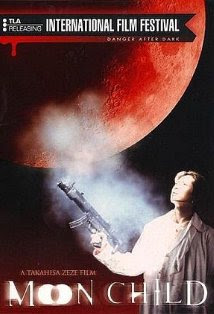
Moon Child on IMDBThe last movie of the set is Moon Child (2003), directed by Takahisa Zeze, and stars J-pop idols Hideto “Hyde” Takarai and Gakuto “Gackt” Kamui (who also co-wrote the script). This film is a futuristic science-fiction martial-arts gay-glam vampire organized crime action horror thriller comedy drama. It follows the life of orphaned Sho (Gackt) and his friends through the first half century of the 21st millennium, when Japan has suffered a major economic collapse and many people have taken refuge in the multi-ethnic “Asian Special Economic Zone” of Mallepa on mainland China. The Mallepa Orphans make their living through robbery and in so doing run into conflict with the Cantonese mafia. The orphans have one advantage, their guardian Kei (Hyde) who happens to be a vampire. Gradually the group of friends falls apart, while Kei is imprisoned. In essence, then, this is a story of love and friendship, the ties that bind. Kei provides the common trope in vampire stories, that is, the loneliness that comes with immortality as friends become mere drops in the ocean, tears in the rain, that wash away in the sad agelessness of the undead. Unfortunately the movie employs those musical interludes – when the writers have to move the story forward, but can’t write a script for the scene. The film also drags on for two full hours, resorts to the cheap and cheesy ploy of cancer to bring Kei and Sho together one last time, and ends with a dual suicide at sunrise. In all, it’s not an awful movie, but it isn’t one that comes with the Cricket’s chirpiest recommendation.

You may now find a follow up of sorts: Danger After Dark II!

[A special shout out goes to Anthony and Sander!]

Wednesday, August 4, 2010

The Box

The Box movie review on NY Times
The premise of The Box (2009) is fairly simple, as you probably know even if you haven’t seen the film: Would you accept a million dollars knowing that by accepting it you will cause the death of somebody, anybody else? It sounds simple enough. Most of us would probably say “yes.” But think of the altruism coefficient (or rather the opposite): if too many people are unable to sacrifice their individual desires, humankind would not survive. That is the message that comes late in the movie. Few of us can see beyond the temptations dangling in front of us and cannot foresee the consequences of our actions. Profound as that sounds, it is at this point that the film unfortunately fails – offering no other resolution than the rather Stoic moral of resisting temptations. In that respect, the movie smacks of Puritan Protestantism. Nevertheless, the story is a real thriller with a dash of science fiction and a hint of horror – and it is unsurprising that the short story on which the film is based (“Button, Button” by Richard Matheson) has also been adapted for The Twilight Zone.

The Lewis family receives a box with a red button under a glass hemisphere and a note that Mr. Steward will call upon them that afternoon. Arthur Lewis (James Marsden) works for NASA, where he developed a 360-degrees camera, but is notified that his application for the astronaut training program is rejected. His wife Norma (Cameron Diaz), a private high school teacher, is informed that faculty will no longer get a tuition waiver for their children. With these setbacks fresh on their minds, Mr. Steward’s offer of a million dollars is a tantalizing temptation. They have one day to make their decision – and after much deliberation, Norma pushes the box’s button to accept the money. Steward arrives to deliver the cash and retrieve the box. He tells them it will be reprogrammed but they do not know the person who will next receive the same offer. Meanwhile, NASA employee Jeffrey Carnes has shot his wife point blank. From that moment, events take weirdly mysterious turns in their life. People show up with secret messages and nosebleeds. Steward seems to know their every move.

The Box movie review by Roger EbertIt is 1976, Lynyrd Skynyrd is at the height of their fame, President Ford is on television, and the Viking mission is broadcasting images from Mars leading to speculations about life on Mars. Arlington Steward (Frank Langella), it transpires, was once hit by lightning while working at NASA’s Langley Research Center. Considered dead, he revived, regenerated at ten times the normal speed, his cell degeneration halted (implying he no longer ages), but his face still displays a scar the shape of the Face on Mars. He is now a vessel for “those who control the lightning” – apparently divine or extraterrestrial beings who are putting humankind to some twisted test. There are references to salvation and eternal damnation, to Sartre and 70s culture in America. There are drones moving like zombies who apparently do Steward’s bidding. With all these conspiracies, plot twists and complications abounding it is disappointing that so many threads remain dangling at the end. With a different ending, I would have said it’s a good movie, but as it is I felt we were bombarded with questions but received unfortunately few answers to anything.

Tuesday, July 20, 2010

The Host

Your Chirping Cricket was recommended to watch The Host (Gwoemul, 2006), the highest grossing film in South Korea. In the horror genre, this is a great monster movie, with a sense of humor and an actually sensible plot. The story revolves around a rather dim-witted man who loses his daughter to an amphibian monster from the Han River. Believing she has died, he grieves with his father, brother and sister. On the last battery power of a cell phone, she calls to tell she is somewhere in a big sewer. The remainder of the film, we follow the family in their chase to find her, while they break out of quarantined hospitals, obtain a truck and a map of the sewerage system with the family’s savings, and attack the monster. It kills the grandfather and the three siblings get separated. The brother is able to trace the girl’s call to the north side of Wonhyo Brigde, but he is betrayed by people who are chasing him for reward money. Meanwhile the young girl remains trapped in the monster’s lair with other victims. The only other one alive in the pit is a homeless kid who is even more scared than her. She tries to climb out by making a rope of clothes, but it catches her again with its tail and then gulps her and the kid in its ferocious mouth.

At this point, Seoul is in uproar as the government has decided to employ Agent Yellow to eradicate the monster and the deadly virus of which it is supposedly the host. The monster attacks the protesters but is incapacitated by the chemical fumes. The three siblings reunite and the girl’s father takes his chance to pull out his daughter as well as the little kid from the monster’s hideous mouth. She has suffocated despite holding on to one of the monster’s teeth. In his anger the father attacks the monster with a street pole, but all that achieves is that it wakes it up. The brother attacks it with fire bombs made of soju bottles. Then a homeless man pours gasoline over the monster, and the sister, a national arching medalist, shoots a flaming arrow into its eye, while the girl’s father rams the pole through its mouth and pierces its brain. With the monster dead, he checks on the little kid and finds that he is still alive. He decides to adopt him as he was with his daughter in the monster’s pit. Months later, when they are having dinner, the news on the TV announces in the background that the “disease crisis” was a case of “misinformation.” They just turn it off.

In fact, we knew from the beginning that the monstrous creature was a mutant amphibian caused by deliberate formaldehyde spillage into the Han River. And that is the running political commentary in this film. For it was an American military pathologist who ordered the formaldehyde to be dumped down the drain; it was the American military that quarantined everyone who got near the monster because of a deadly virus that never existed, and then ordered to perform a frontal lobotomy on the girl’s father; and it was the American military that employed Agent Yellow (a thinly veiled reference, of course, to Agent Orange). The monster, in other words, is a metaphor for America’s military presence in South Korea, and the family’s resilience is an ode to self-reliance and national sovereignty. The monster itself is quite a marvel of a mutant hybrid, with its elegant acrobatics, its clumsy legs, its ugly jaws and frightful tail. Interesting, too, is that the monster creature appears almost at the beginning, unlike in so many other films of the “creature from the deep” genre. The film is not screaming bloody gore, it has intelligent drama at the heart of the story, and the action scenes are highly entertaining. You might want to watch it, too.

Wednesday, June 23, 2010

Pi

In the genre of weird movies, there’s also π (1998) by Darren Aronofsky (who also directed Requiem for a Dream). The story’s main character, Max Cohen, believes that everything in the universe adheres to patterns that can be understood through numbers. At first he’s using his self-made supercomputer to predict the stock market. But then he meets a zealous Hasidic Kabbalist who hopes to decipher god’s code in the Torah through numerical calculations. At the same time, Max has been approached by a Wall Street firm, who offer him a superchip in return for his predictions. His computer prints out a string of 216 numbers, just like his old computer did before breaking down, just as his math mentor had just before he died, and through some epiphany he recognizes the spiral-shaped patter in the number-string. The Kabbalist and the Wall Street firm increase their pressure on Max, which sends him over the edge of sanity.

The film toys with the thin line between genius and insanity – the maddening truth, the truth in madness, like an Arthur Machen story, or a Terry Gilliam film. Perhaps the most profound statement in the movie is the mentor’s admonition, that “as soon as you discard scientific rigor, you are no longer a mathematician, you’re a numerologist.” This film is no advocate for scientific truths, though, as Max suffers from incapacitating migraines, nosebleeds, crippling hallucinations, paranoia, and possibly schizophrenia. In the end he drills a hole in his skull to be at peace – and never again think about numbers and patterns. Apart from the art-house hip black-and-white and the interesting soundtrack, I found the cinematography terribly annoying – what with the handheld shots, the quick cuts, and the extreme close-ups. Nevertheless, for those who wish to contemplate the ultimate truth – and whether to find it through science or mysticism – this may not be the worst way to spend your time.

Wednesday, June 16, 2010

New Rose Hotel

I doubt many people ever saw Abel Ferrara’s New Rose Hotel (1998), some kind of cyberpunk erotic thriller, starring Christopher Walken, William Dafoe, and Asia Argento. Care to know what cyberpunk is, perhaps? It’s another excuse for soft-core porn. Not that there’s anything wrong with girls getting naked – in this case Argento and a whole slew of anonymous Asian chicks. But shall I just come out and call a spade a spade? This film is bull-shit. The set up is actually interesting enough: two corporate raiders are promised $100 million if they kidnap a top genetic scientist from a rival company; in their ploy the two use an Italian Shinjuku call-girl to seduce the scientist into defecting.

If my initial enthusiasm was tepid, my interest waned fast, as the film grew ever more turgid. What should have been the thrilling dramatic climax, was nothing but dull fizz: the scientist and his new colleagues are killed by a lethal virus. The worst part was that after sitting through this horse manure for an hour, the film literally started repeating itself, tossing random scenes our way from the first two-third, adding more lurid sex for good measure. We learn that Argento’s call girl was never a pawn in the game of the two men, that in fact she seduced Dafoe’s character, and that she carried to information to reprogram the lab’s DNA synthesizer. Blahdeeblah ... yawn ... Can I go now? My popcorn turned stale.

Monday, April 5, 2010

Jacob’s Ladder

Have you ever seen the movie Jacob’s Ladder (1990)? A friend of mine told me I should watch it. It’s one of those psychological thrillers known in French as a mindfuck. Man, what a film! You never know what’s real and what’s nightmare. We start in the Mekong Delta, 1971, and suddenly the platoon is under fire, but not from the Viet Cong. And then, suddenly, we’re on the C Train, NYC, Bergen Street, B’klyn, and Jacob Singer (Tim Robbins) is unable to find an exit that’s still open, he crosses the tracks, and nearly gets hit by a train, with faceless passengers inside! When he finally comes home we learn that he has a gorgeous little girlfriend called Jezebel (Alexandra Peña), he works as a postman along Nostrand Avenue. (That’s right where I lived!!!) Gradually more and more weird things are happening to Jacob. He’s seeing the most bizarre creatures, he’s hallucinating, he’s going through hell, he’s afraid he’s going paranoid, he collapses at a party, running a terrible fever. Then he wakes up from a nightmare, finding himself in bed with his wife Sarah... his eldest son Gabe is still alive ... he never went to Vietnam ... But wait, no-o-o-o-o, he didn’t wake up from a nightmare ... The nightmare is real!

Jacob is eventually approached by someone who claims to have been a chemist involved in experiments in Vietnam to increase the soldiers’ aggression by means of some type of drug called “The Ladder”. At the funeral of one of his war buddies, he learns that his surviving platoon mates suffer similar hallucinatory nightmares. They decide to file a law suit against the government. But soon his friends from Nam back out and their lawyer tells him there’s no proof they ever went to Vietnam! Things really start to get interesting when he’s coming out of the supreme court building and he’s kidnapped by guys in suits. He’s tortured ... with his girlfriend Jezebel right there! Close toward the end we see him walk up a staircase with his son Gabe... But then we see his dead body still in Vietnam... Apparently we are to understand that everything we saw before was merely a dying hallucination, a purging vision in which Jacob lets go of his earthly attachments before he ascends the eponymous Ladder to heaven... bummer... Still, I’d recommend this movie to everyone who wants to scare themselves silly. But then again, I just gave away the ending... Hmmm...

Monday, March 29, 2010

Funny Games

Have you ever seen the movie Funny Games (1997)? (Not the Hollywood frame-by-frame remake, I hope, but the German original.) This is another one of those weird movies, like Man Bites Dog and Delicatessen... I’ve been meaning to check this one out for quite some time, too... The title refers to the sadistic “funny games (komische Spiele)” that these two charming-looking lads unleash onto two completely unsuspecting vacationers and their kid. It’s the most awkward and uncomfortable movie experience, yet I couldn’t stop watching ... I had to see what inhumanely humiliating hoax these guys come up with next! None of the more gory, torturous scenes actually happen on-screen. That’s left to our imagination... But it’s already enough. Michael Haneke is clearly a director who enjoys long single shots in which the camera moves little or not at all, and he enjoys long awkward silences... The most charming of the two torturers keeps addressing the audience, winking and talking to us, even using a remote to rewind the action, thus breaking the fourth-wall, alienating us from the narrative, forcing us to realize we are only watching a movie ... making us wonder why on earth we are actually watching such a tediously torturous movie about random violence... Best not to watch this on your own at night if you’re skittish about going to sleep alone in the dark...